A Paris Artist’s Studio Set on the Street Where the Statue of Liberty Was Built
Bedrooms: 1 Bathrooms: 1 Interior: 92 m² / 990 sq ft
Amenities: Top-floor duplex, 6-metre / 20-foot ceilings, large balcony, rooftop views, monumental fireplace, wood panelling, studio windows, office or dressing area, en-suite bedroom, elevator, caretaker.
Before the Statue of Liberty stood over New York Harbor, she rose above the rooftops of Paris.
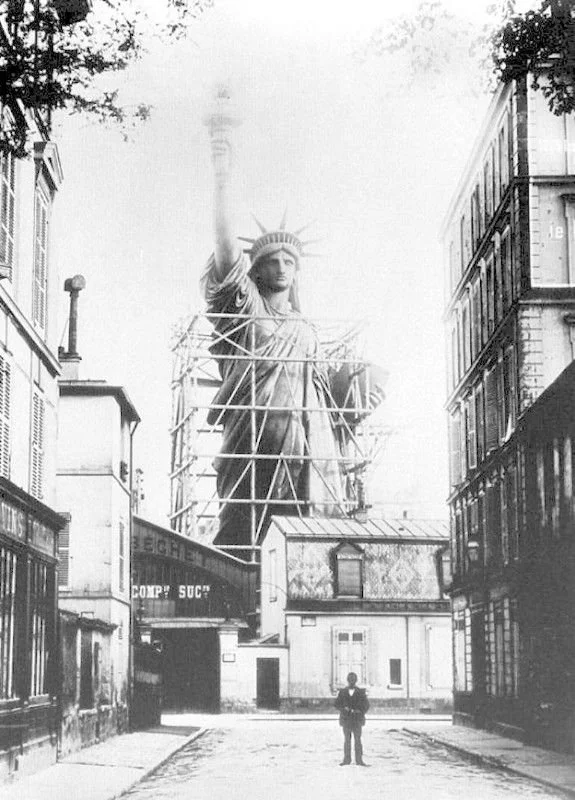
The Statue of Liberty assembled at the Gaget-Gauthier workshops on rue de Chazelles in Paris, 1884. Photograph by Albert Fernique. Musée Carnavalet – Histoire de Paris / Paris Musées.
Beside Parc Monceau in Paris’s 17th arrondissement, the quiet rue de Chazelles became the construction site for one of the world’s most recognisable monuments.
In the late 19th century, Frédéric-Auguste Bartholdi oversaw one of the most ambitious sculptural projects of his generation here, where the 46-metre / 151-foot copper figure was constructed and temporarily assembled at the workshops of Gaget, Gauthier et Cie before being dismantled and shipped across the Atlantic.
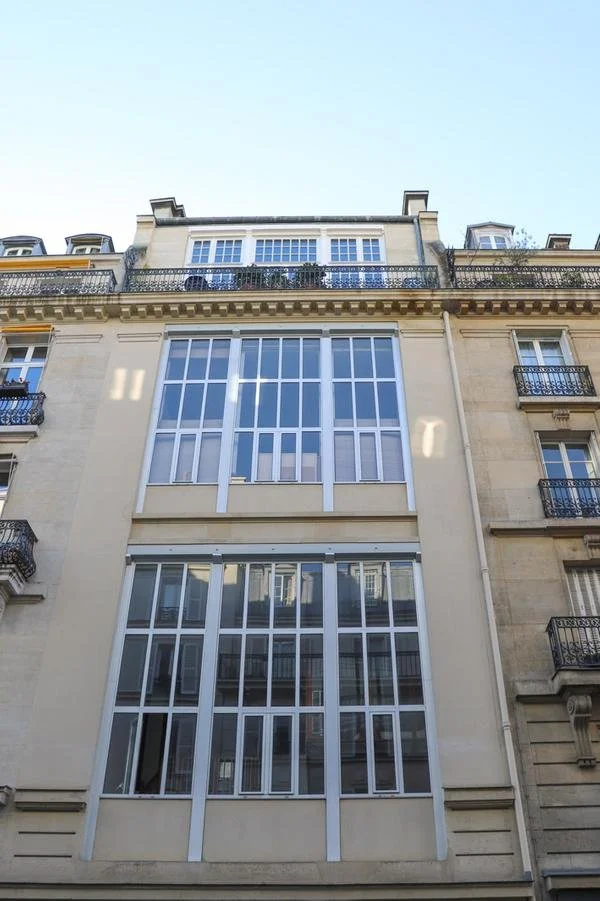
Today, on the same historic street, a former artist’s atelier is on the market with Jeudi Paris Real Estate for €1.68 million.
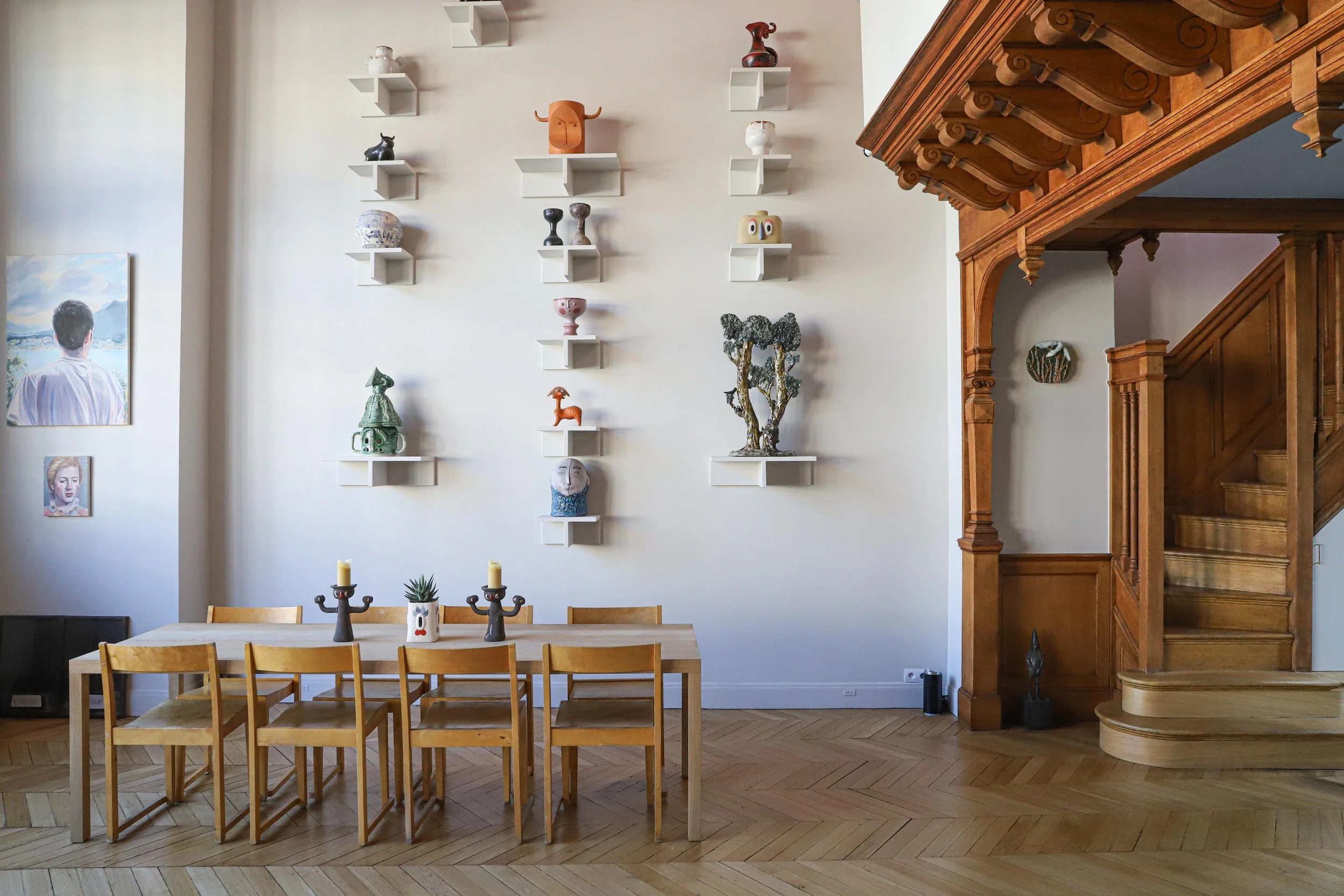
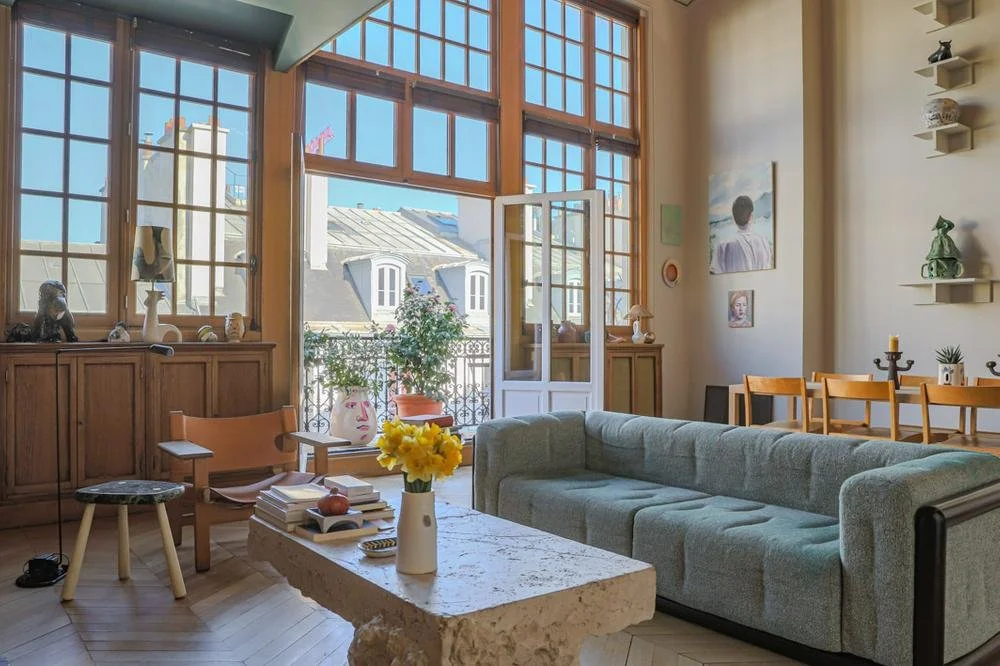
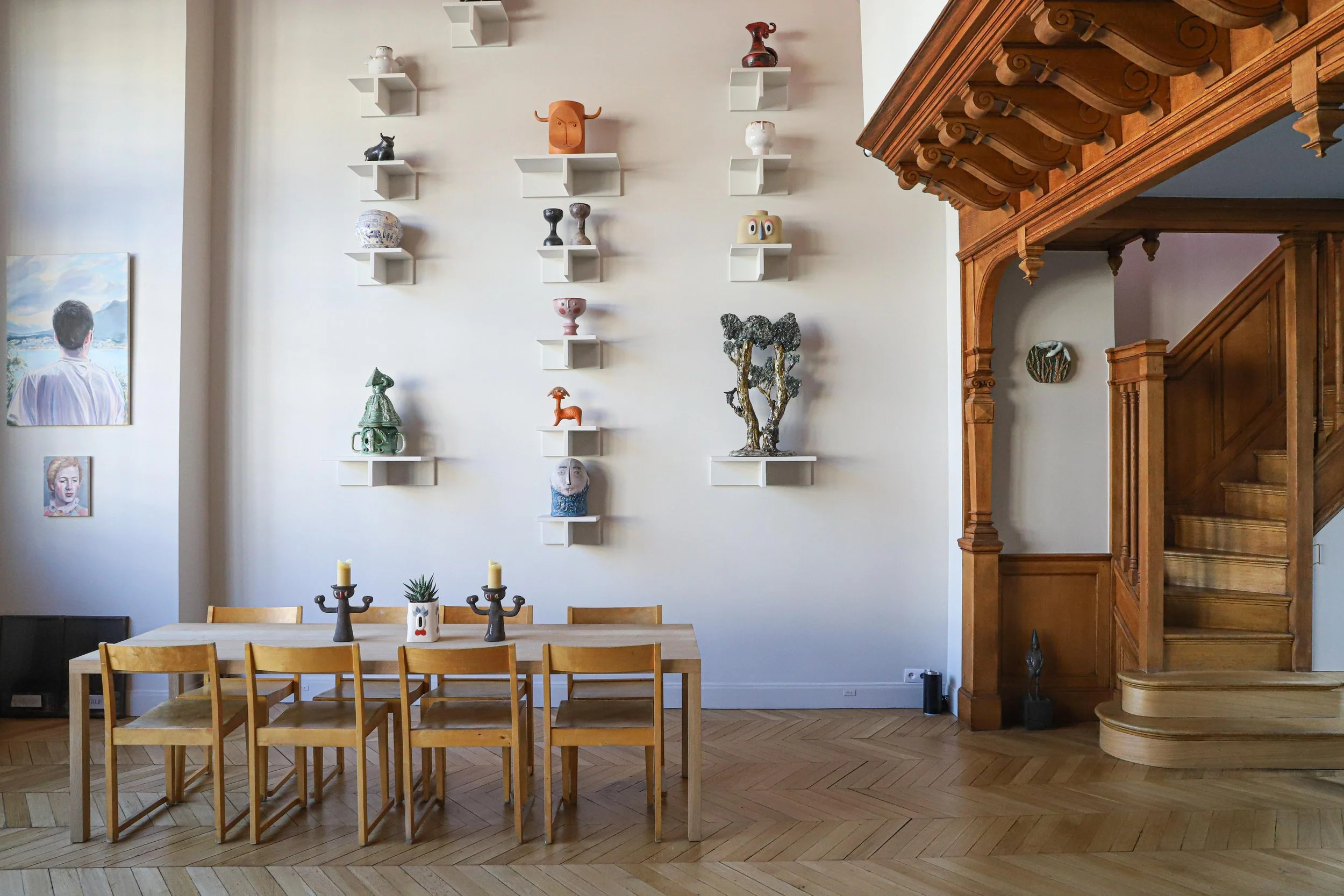
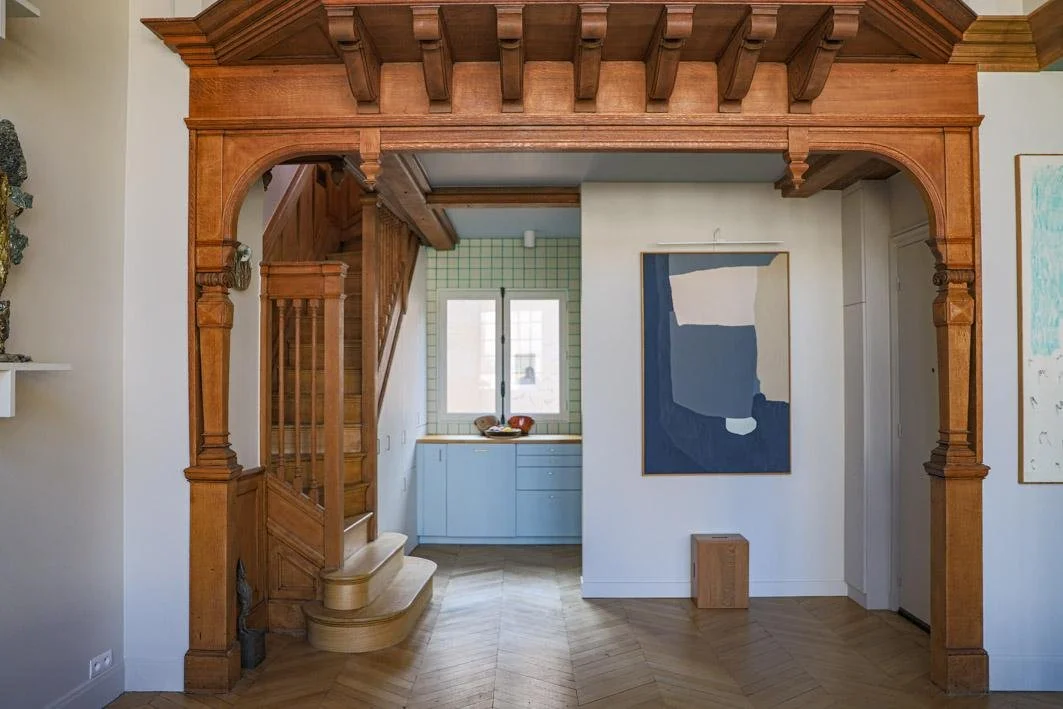
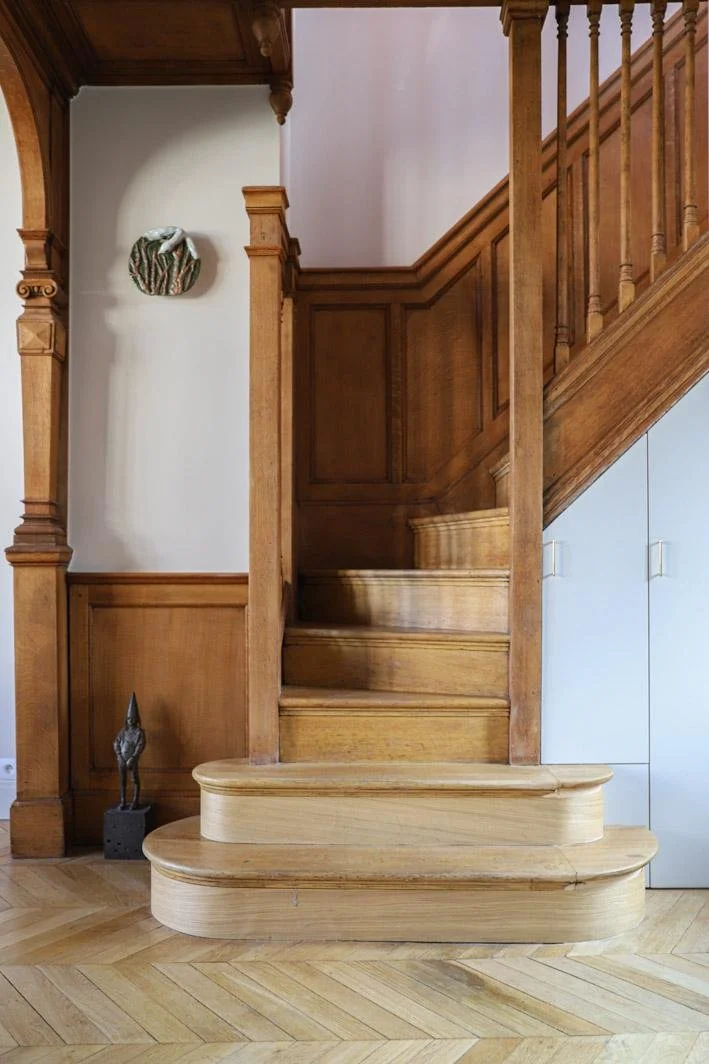
Wall-mounted consoles display the owner’s ceramics in the apartment’s double-height reception room, beside the carved wooden staircase and original wood panelling. Jeudi Paris Real Estate
An Artist’s Atelier on Rue de Chazelles
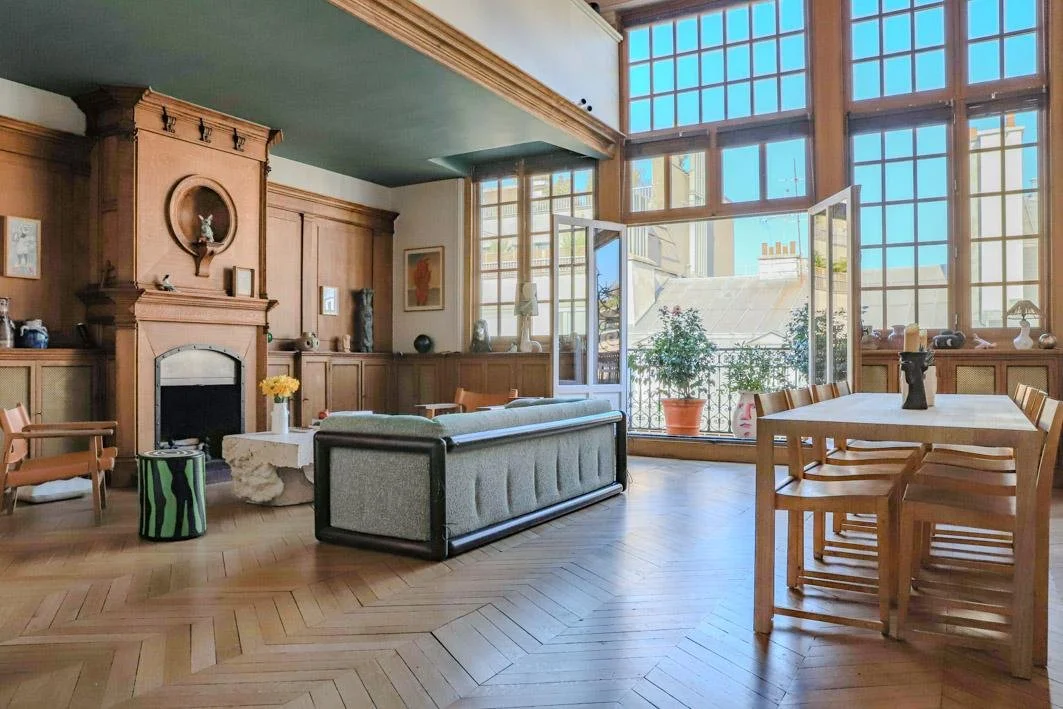
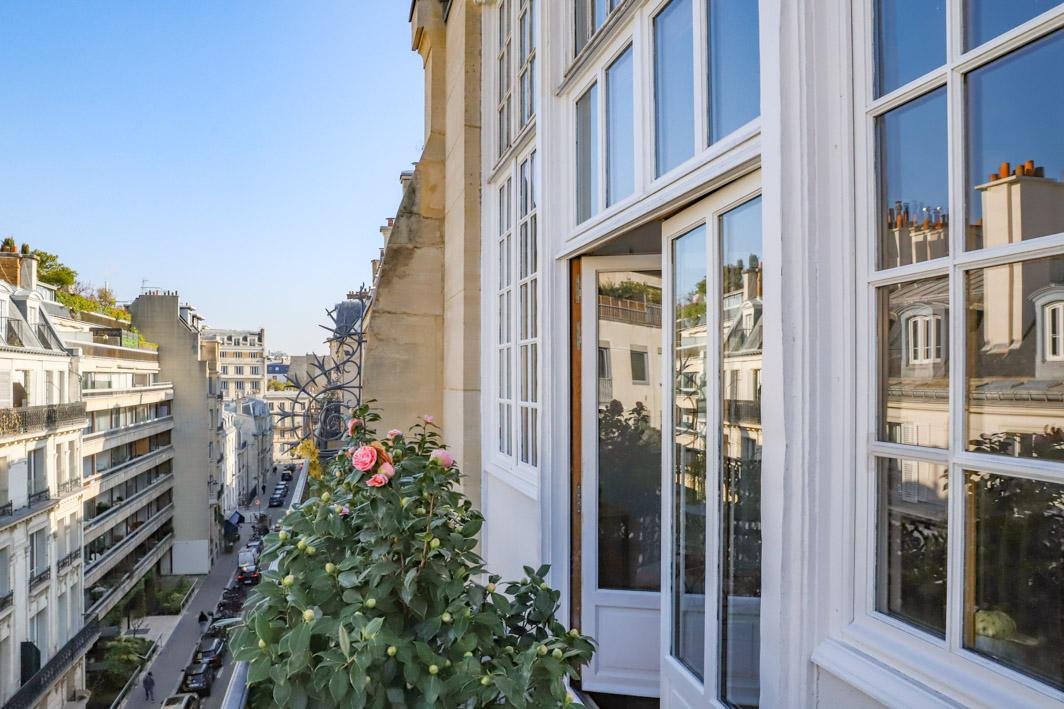
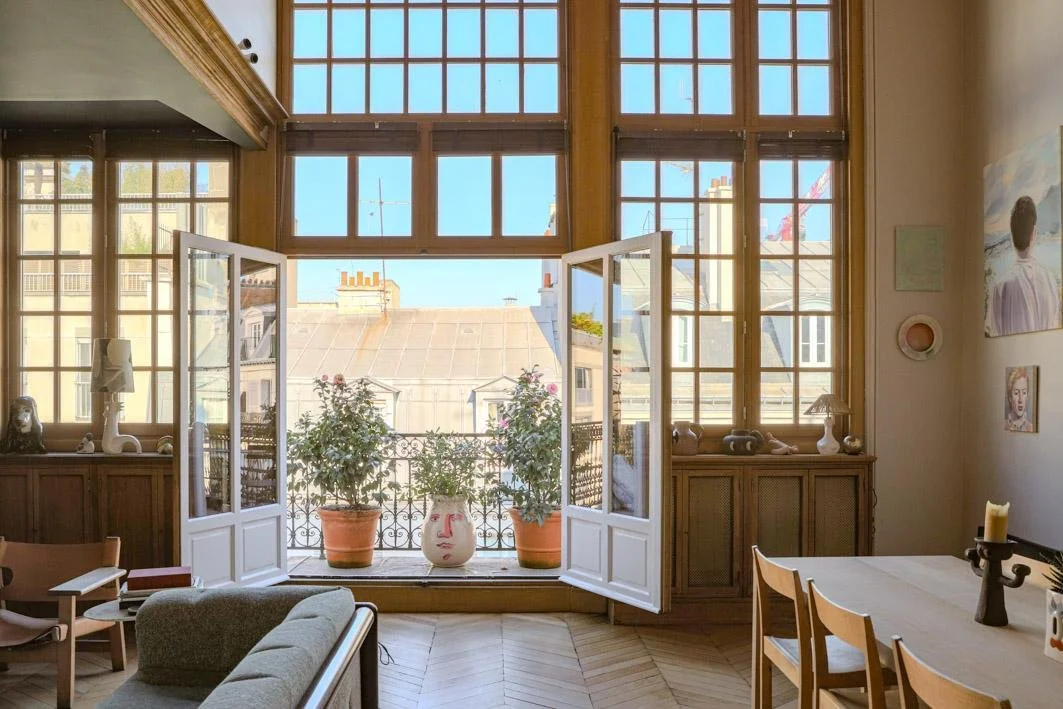
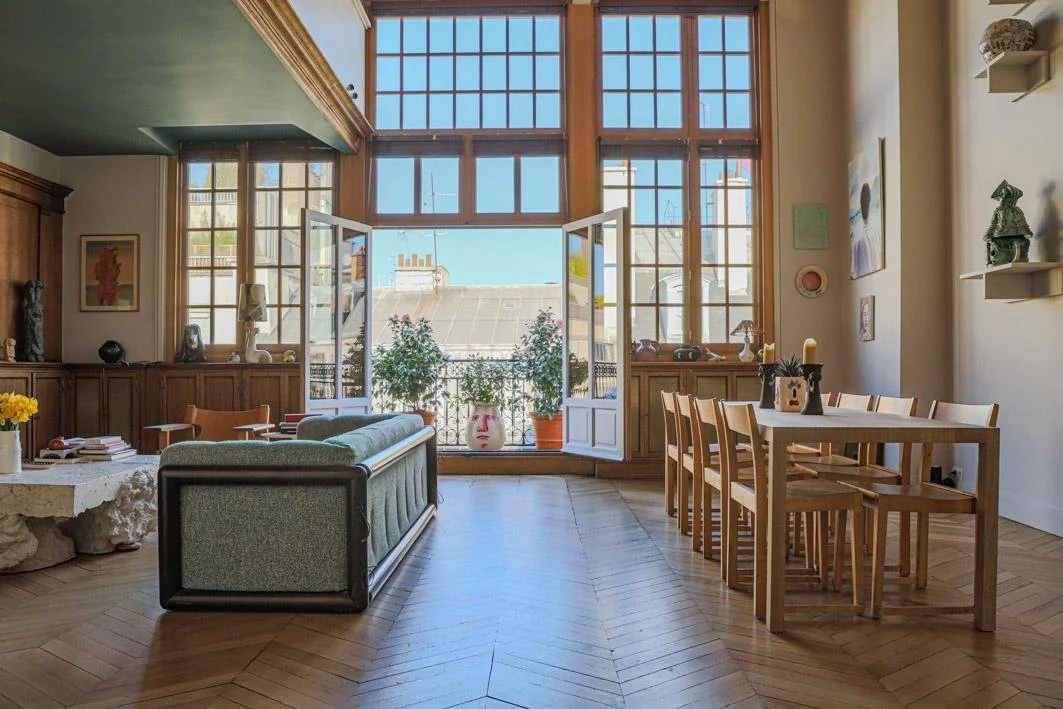
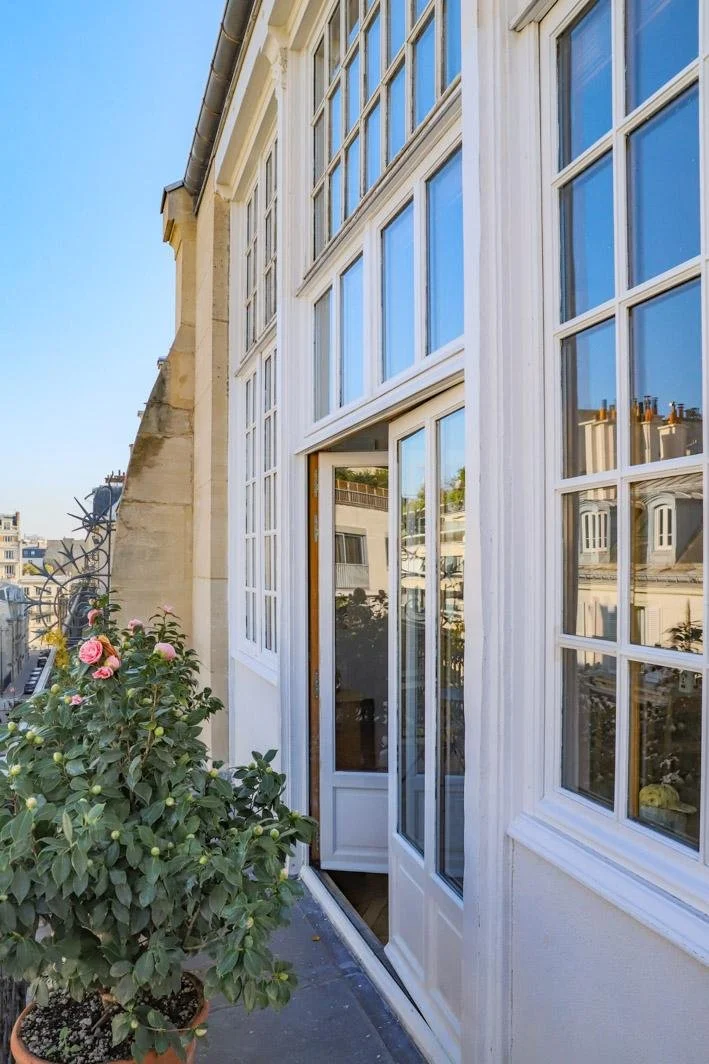
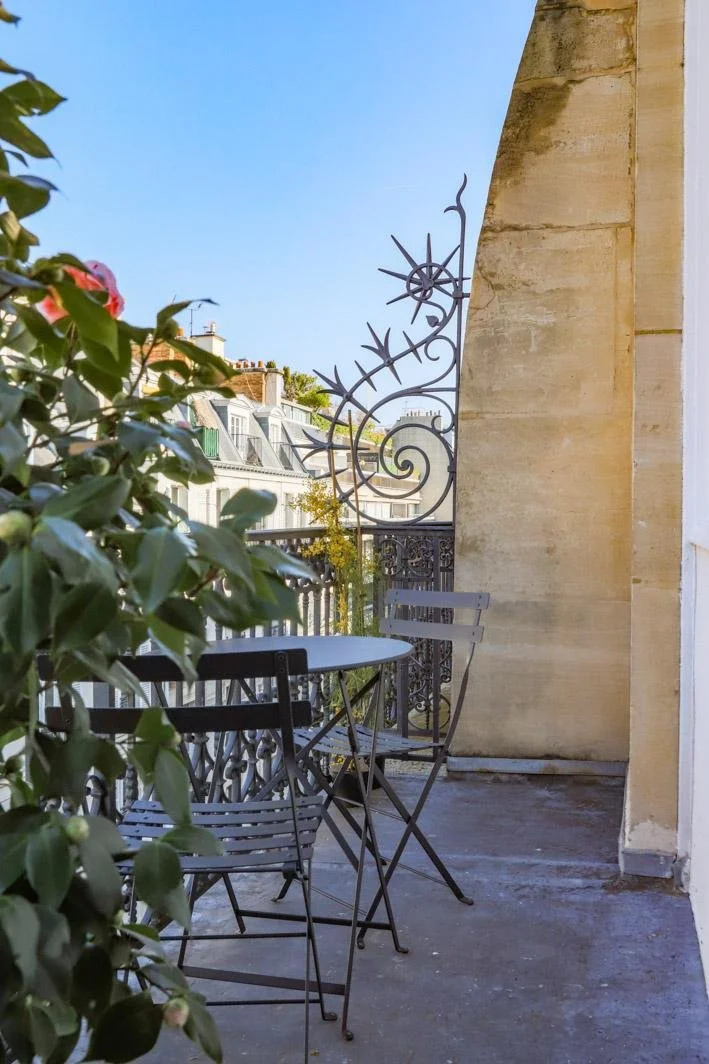
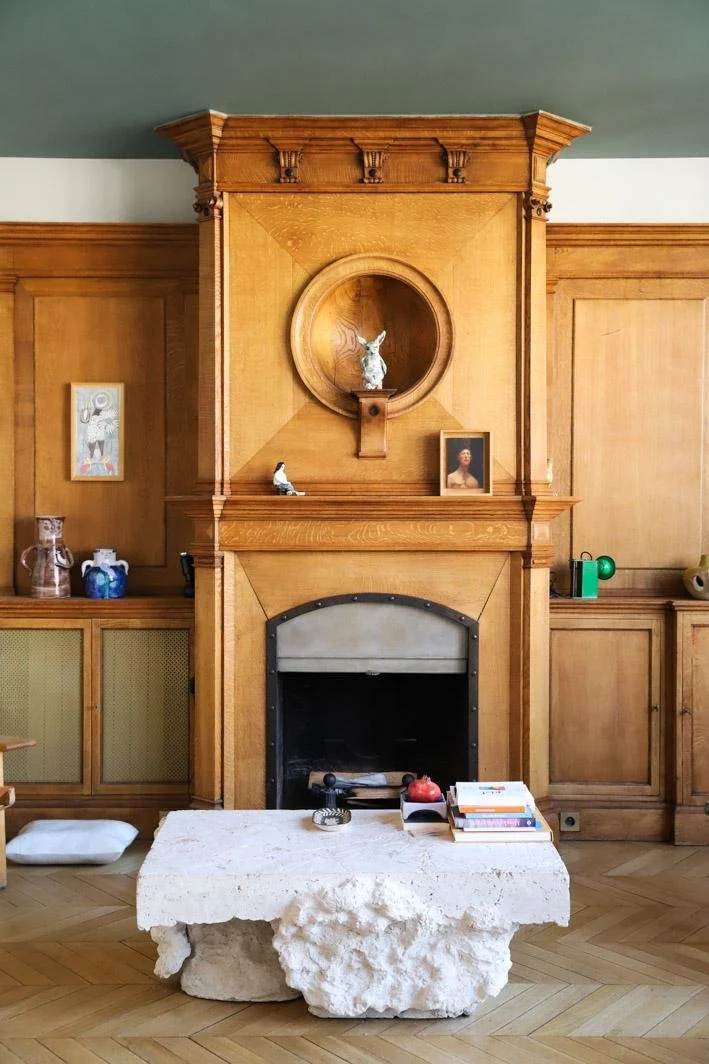
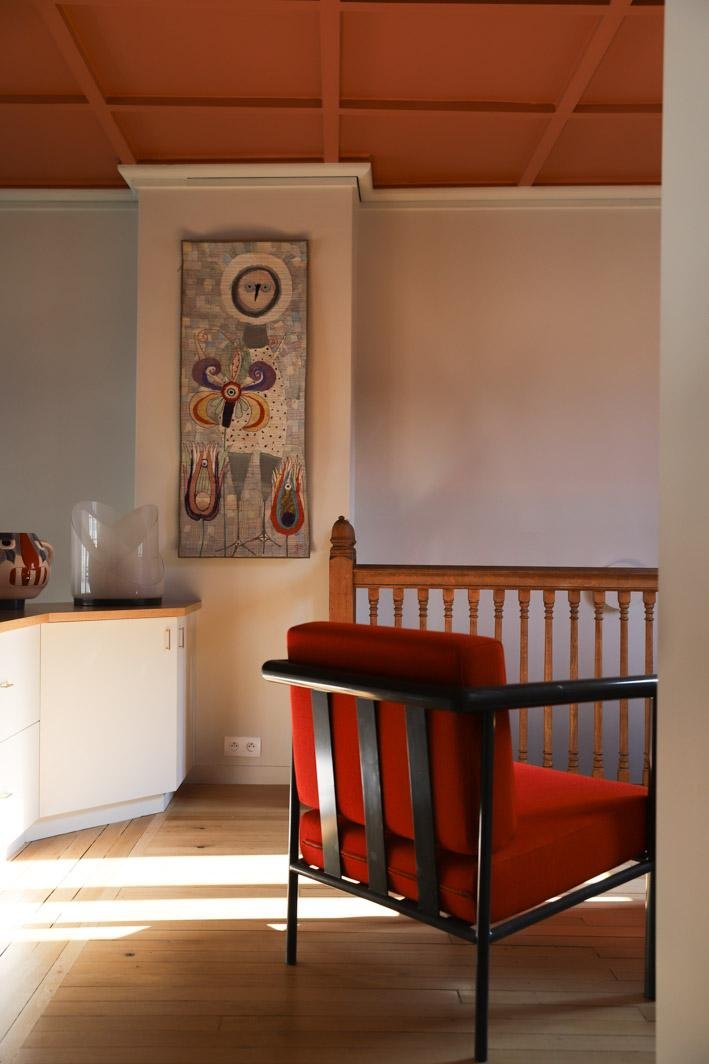
Spanning approximately 92 m² / 990 sq ft, the two-level top-floor apartment is arranged around a dramatic reception room with 6-metre / 20-foot ceilings, a monumental carved fireplace, wood-panelled walls and towering studio windows. French doors open onto a broad balcony with views across the rooftops of Paris.
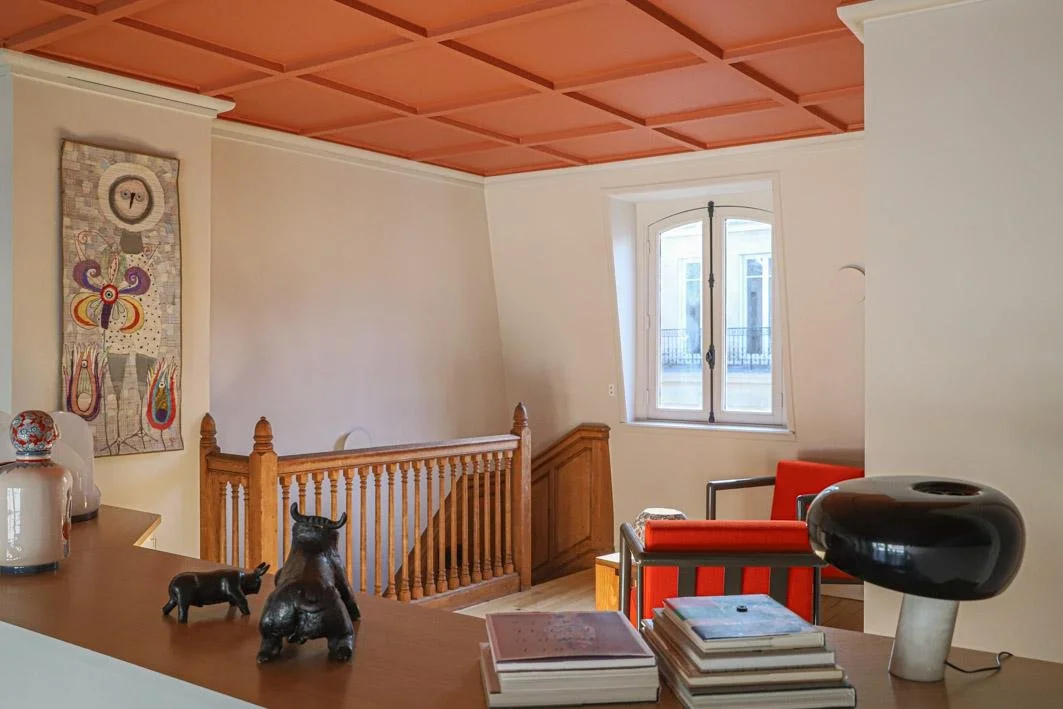
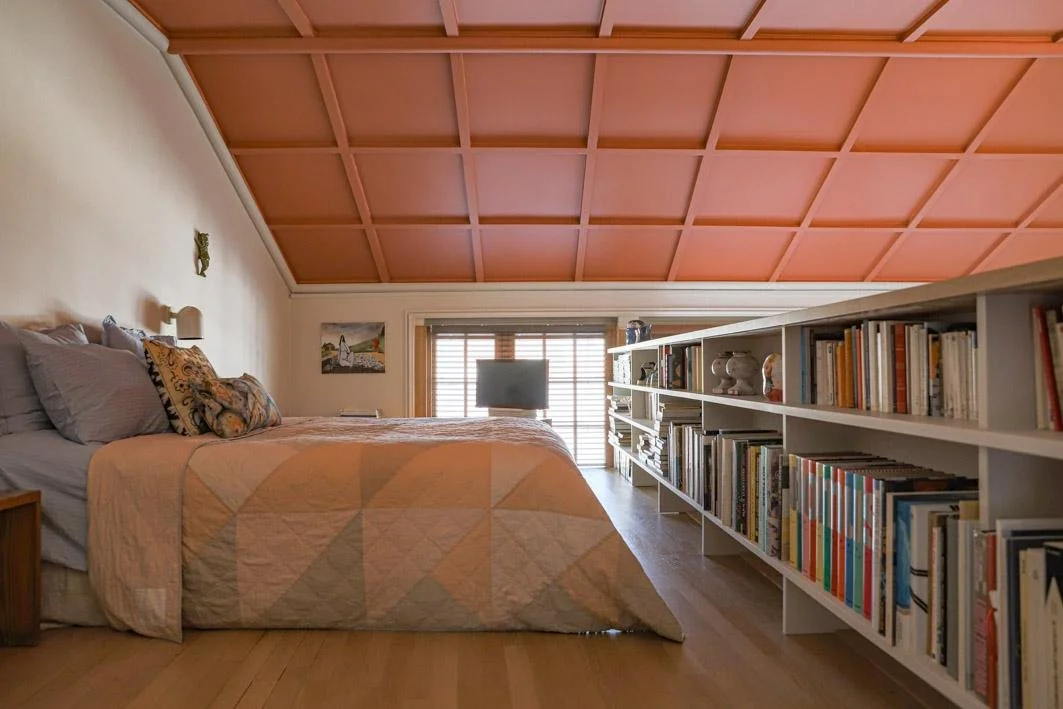
A carved wooden staircase rises to the upper level, home to an office or dressing area and an en-suite bedroom set beneath a coffered ceiling.
The apartment was most recently home to ceramicist, collector and CMJ Studio founder Julien Michaud, who brought in his longtime friend, interior designer Robert Normand, to rethink the space around his collection of ceramics and contemporary art.
The pair had worked together before, on Michaud’s communications agency and several of his previous Paris homes. Over the years, Michaud had lived in a studio floating above the rooftops near Porte Saint-Martin, an apartment overlooking the Moulin Rouge and, more recently, a home with a broad balcony facing a hidden garden.
He likes changing the type of space he lives in. The objects that follow him from one home to the next, he says, take on a different character each time.
Rue de Chazelles presented something new again.
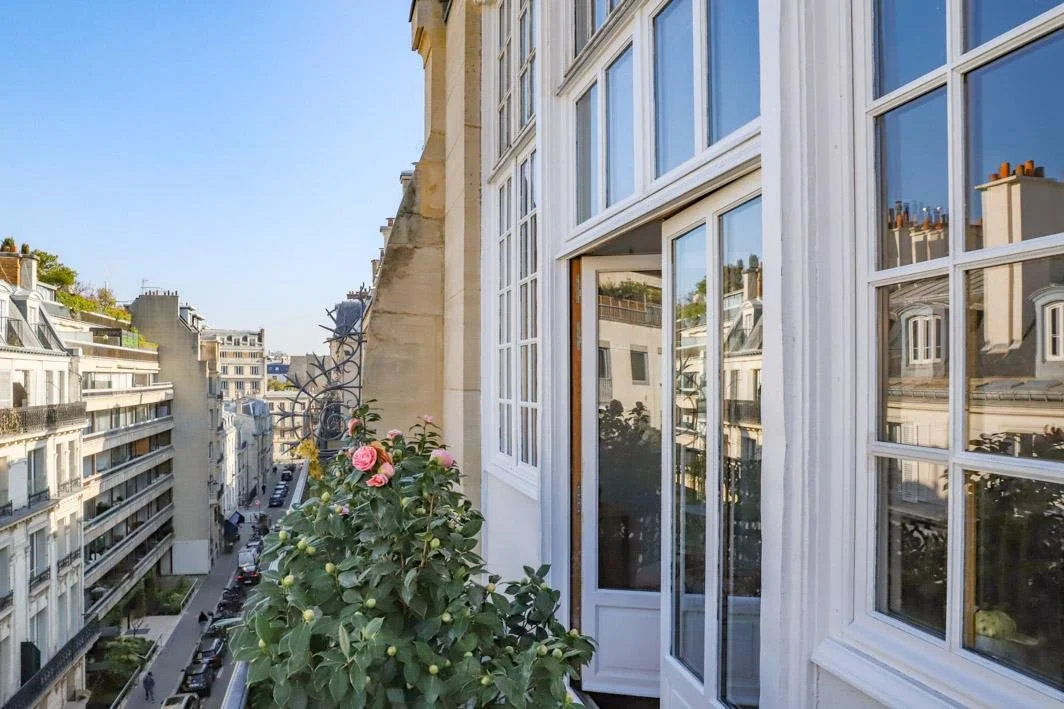
Looking across the rooftops from the balcony, it is easy to imagine the 46-metre Statue of Liberty looming above this part of Paris during its assembly in the early 1880s. Jeudi Paris Real Estate
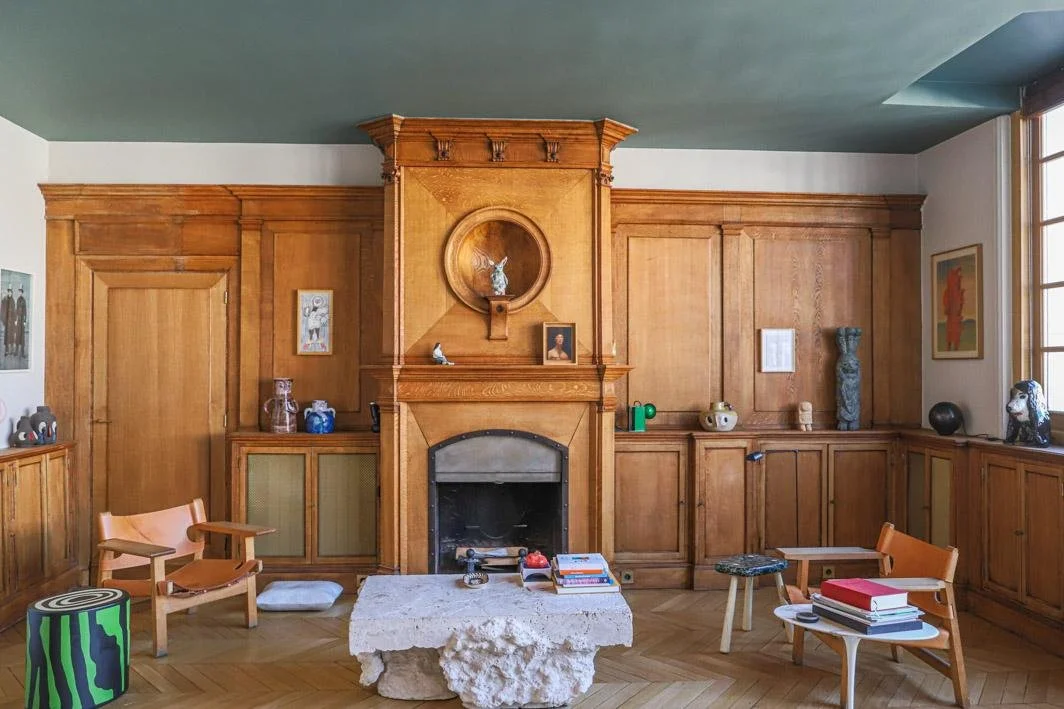
The atelier already had plenty of personality. Renaissance-inspired wood panelling wrapped the main room, while the carved fireplace and soaring proportions gave the space an almost stage-like quality. The previous scheme had leaned into the drama with crimson damask and heavily dressed ceilings.
Normand’s approach was to calm things down without stripping away what made the apartment unusual.
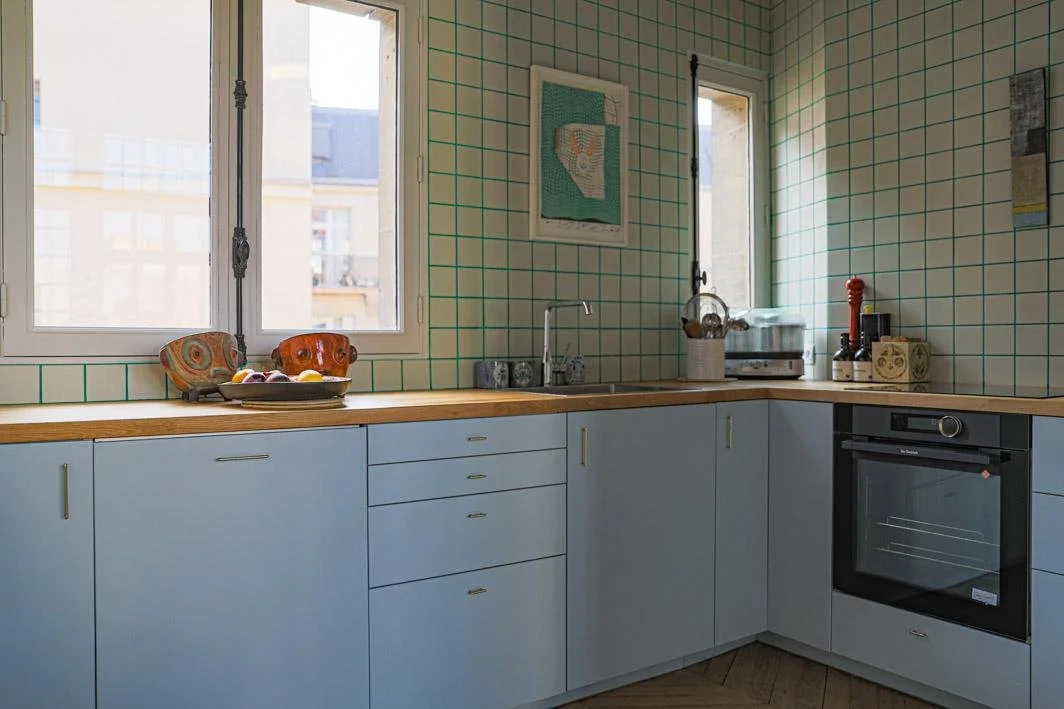
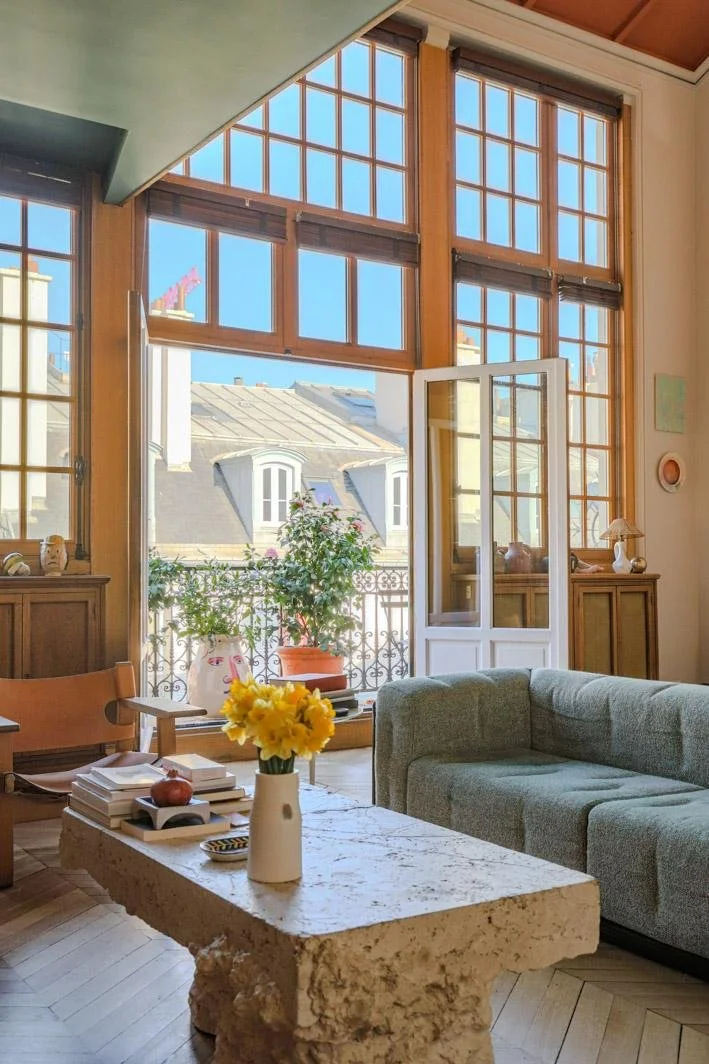
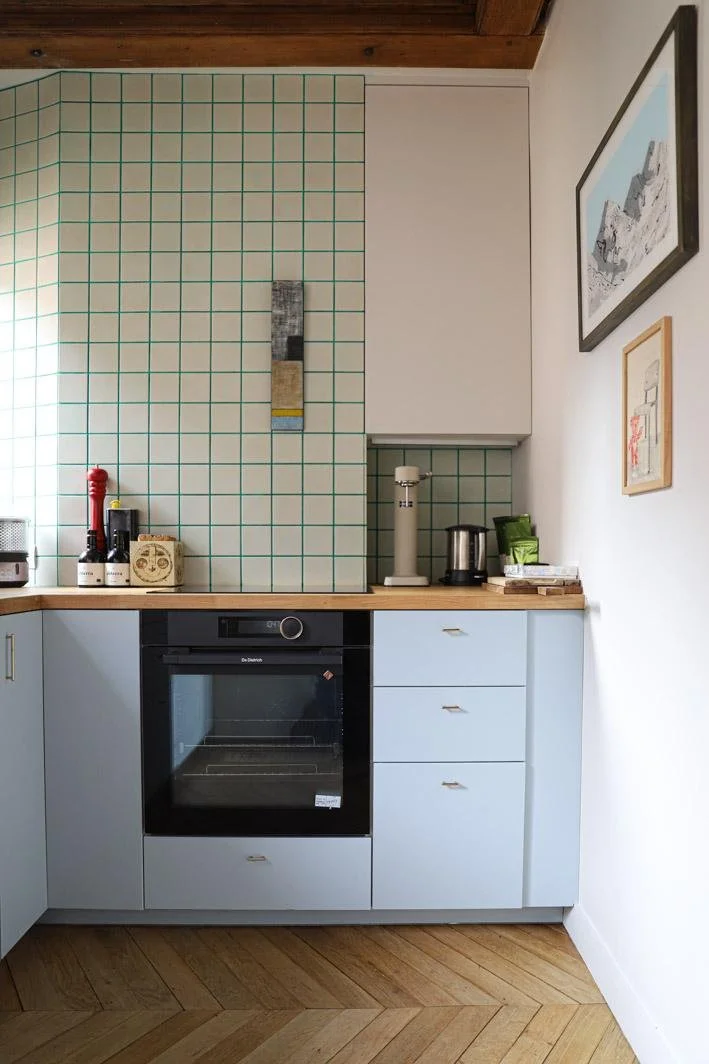
The walls were quietened to create a backdrop for Michaud’s collection, while colour moved overhead instead: terracotta across the main reception room, green beneath the mezzanine and a pale sky blue around the kitchen. Baby-blue cabinetry, white tiles and turquoise grout bring a much lighter note to the late 19th-century interior.
For Michaud’s ceramics, Normand designed a series of wall-mounted consoles, effectively turning the apartment into a private gallery for his collection and his own work.
The living room played the apartment’s old-world woodwork against much sharper modern design. A Carlo Scarpa sofa, a pair of Børge Mogensen chairs and a cardboard coffee table by Frédéric Imbert brought a more brutalist edge to the otherwise classical room.
It is a compelling Paris interior in its own right. But the most extraordinary part of the story is the address.
The Paris Street Where Liberty Was Built
At number 25 rue de Chazelles, the workshops of Gaget, Gauthier et Cie became the place where Bartholdi’s Liberty Enlightening the World was physically fabricated and assembled.
Had you stood on this part of the street in the early 1880s, a 46-metre copper woman — roughly the height of a 15-storey building — would have been rising above the surrounding rooftops.
To understand why she was there, the story starts not with Bartholdi, but with Édouard de Laboulaye.
Laboulaye was a French jurist, abolitionist and committed admirer of American democracy. In the years surrounding the end of the American Civil War and the abolition of slavery, he saw the United States as an important test of the ideals written into its own Declaration of Independence.
A monument celebrating American liberty would mark the centennial of independence and the long relationship between France and the United States. But it also carried a message closer to home.
For Laboulaye, celebrating American democracy was, in part, an argument about France and the kind of country it might become.
The project eventually found its sculptor in Frédéric-Auguste Bartholdi.
Born in Colmar in 1834, Bartholdi moved to Paris with his family as a child and trained in the city’s artistic circles. He later travelled through Egypt and Yemen, where the monumental scale of ancient architecture and sculpture left a lasting impression.
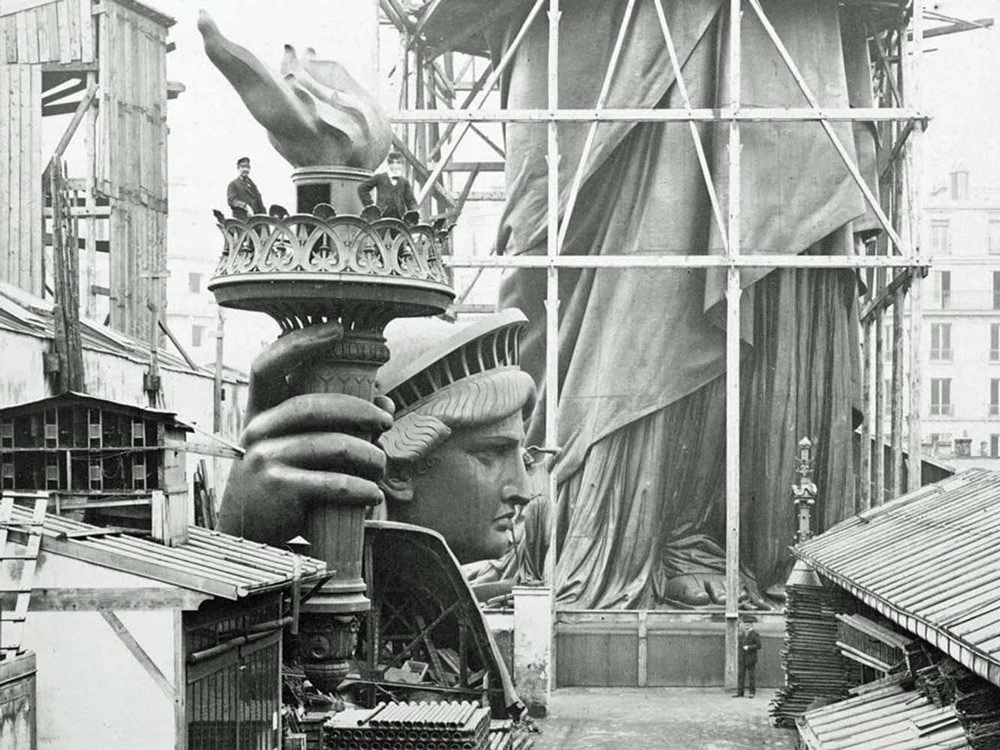
The Statue of Liberty’s completed head and torch beside the partially assembled figure at the Gaget-Gauthier workshops on rue de Chazelles in Paris. Arcanum Paris
Bartholdi thought big. Years before Liberty, he had already explored the idea of a colossal torch-bearing woman for an unrealised monument at the entrance to the Suez Canal. He later created the monumental Lion of Belfort, commemorating the city’s resistance during the Franco-Prussian War — a smaller version of which still stands at Place Denfert-Rochereau in Paris.
But Liberty Enlightening the World would become the project that defined much of his career.
The arrangement was simple in theory. France would raise the money to design and construct the statue. The United States would build and fund the pedestal.
In 1871, Bartholdi travelled to America to advance the project and choose a location.
Arriving in New York Harbor, he settled on Bedloe’s Island, now Liberty Island, a small island positioned at the entrance to the port. The site was visible to ships approaching New York and had exactly the kind of theatrical geography Bartholdi understood.
Liberty would not be hidden in a city square. She would announce herself from the water.
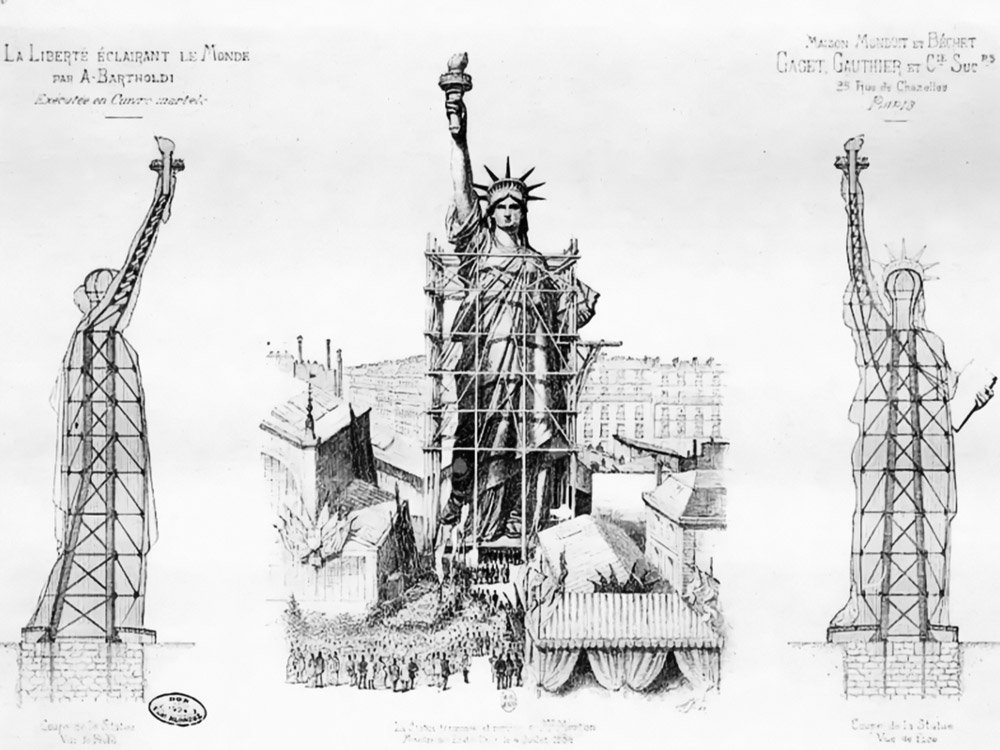
An 1884 construction sheet showing the Statue of Liberty and different phases of its assembly at the Gaget, Gauthier et Cie workshops on rue de Chazelles in Paris. Bibliothèque nationale de France / Gallica.
Building a 46-Metre Copper Woman
Back in Paris, the physical problem of creating her began.
The project took over the workshops of Gaget, Gauthier et Cie on rue de Chazelles. Bartholdi started with reduced models, then enlarged individual parts of the figure to full scale.
Plaster forms and wooden structures were created for each section, and craftsmen used the repoussé technique to hammer thin copper sheets into shape.
Around 300 copper sections, in places only a few millimetres thick, eventually formed the statue’s outer skin.
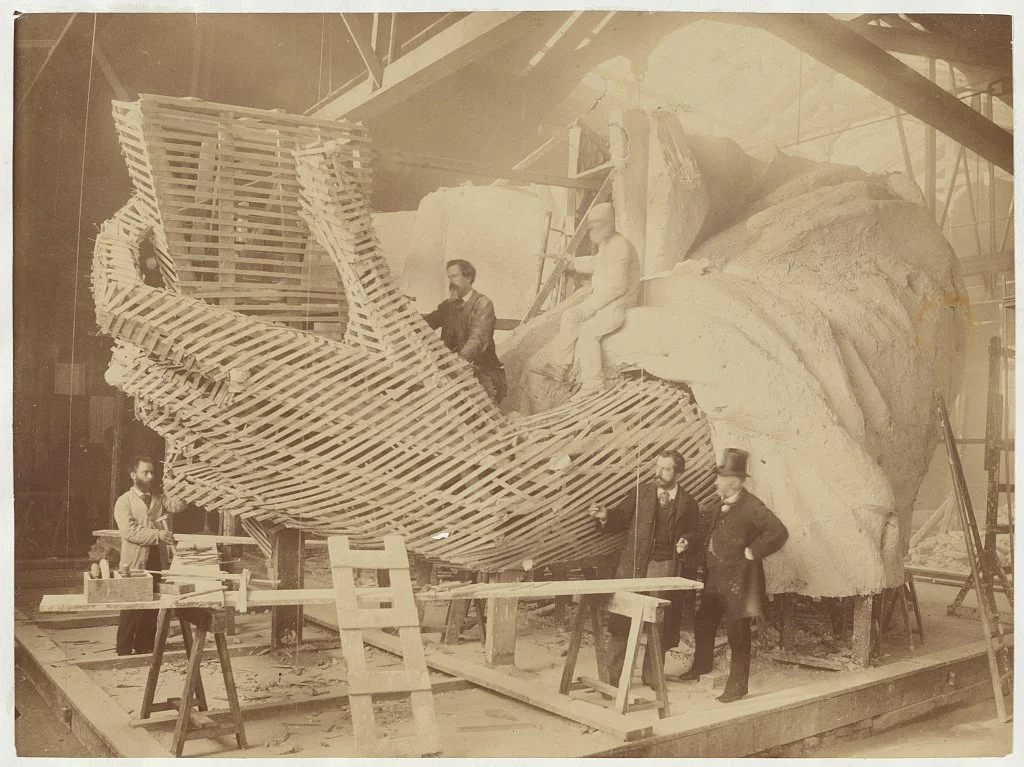
The Statue of Liberty’s left arm and hand under construction at the Gaget, Gauthier & Co. workshops in Paris, 1881–1883. Photograph by Pierre Petit / Library of Congress.
And this was not a quiet sculptor’s atelier.
One contemporary description of the rue de Chazelles workshops recalled the constant sound of hammers, files and chains, comparing the site to an enormous factory.
The archival photographs give a sense of the scale.
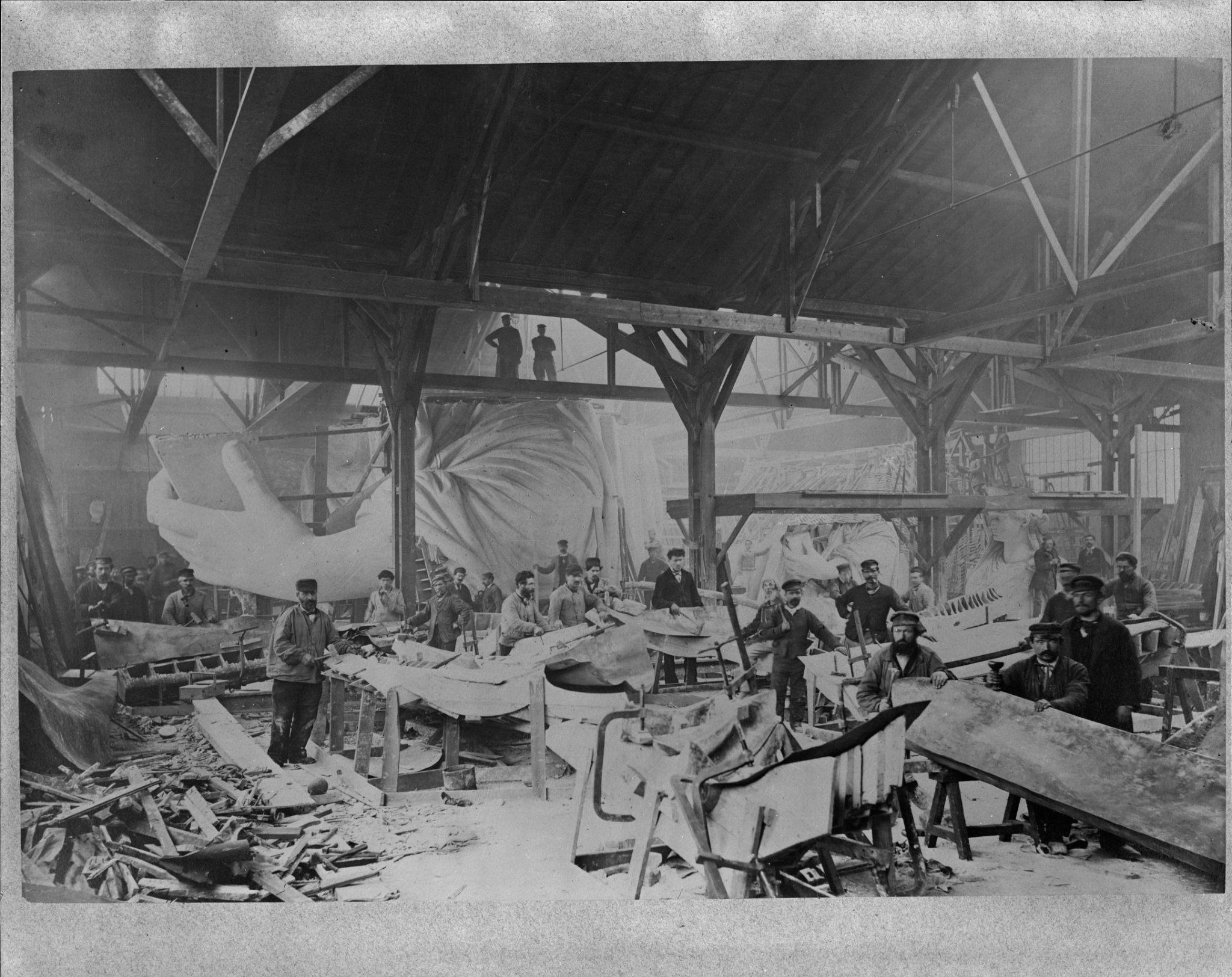
Workers shaping and hammering copper sections for the Statue of Liberty at the Gaget, Gauthier & Co. workshops in Paris, with the statue’s monumental hand and head visible behind them, 1881–1883. Photograph by Pierre Petit / Library of Congress.
Bartholdi Built the Figure. Eiffel Made Her Stand.
Bartholdi could give Liberty her form. The harder question was how to keep such an enormous figure standing once she reached the exposed waters of New York Harbor.
The statue’s first structural plans had been developed by Eugène Viollet-le-Duc, the architect best known for his restoration of Notre-Dame de Paris. When he died in 1879, Bartholdi turned to another French engineer whose most famous work was still years away.
Gustave Eiffel had not yet built the Eiffel Tower.
What he was asked to solve on rue de Chazelles was already an extraordinary engineering problem: Liberty’s outer skin was made from thin sheets of copper, yet the completed figure would stand 46 metres high, exposed to strong harbour winds and the constant expansion and contraction of metal as temperatures changed.
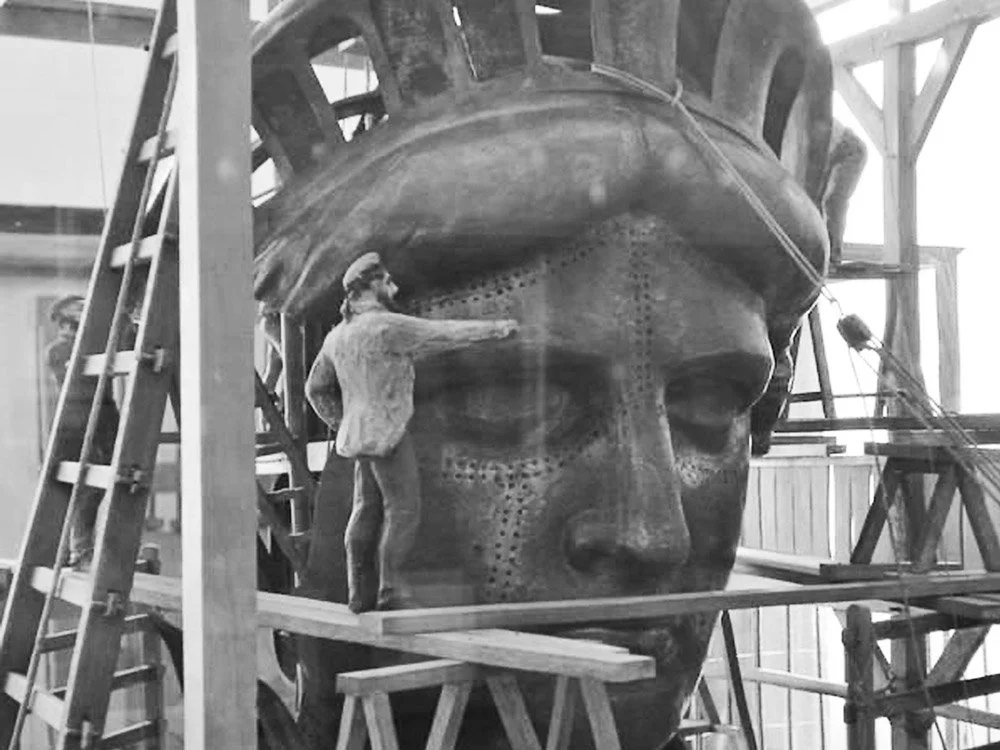
A worker beside the colossal copper face of the Statue of Liberty during its construction in Paris. Arcanum Paris
Eiffel designed a 28-metre / 92-foot central iron pylon inside the statue, surrounded by a lighter framework that connected the structure to Bartholdi’s copper skin. Crucially, the copper was not locked rigidly to the iron skeleton. The system allowed the outer surface a degree of independent movement as the monument responded to wind and temperature.
Years later, Eiffel would become synonymous with the iron tower rising over Paris for the 1889 Exposition Universelle. But some of the thinking that made his name — lightness, exposed metal structure and engineering at monumental scale — was already at work inside the Statue of Liberty.
Liberty, Piece by Piece
Eventually the full figure appeared above the buildings beside Parc Monceau. Parisians reportedly became so accustomed to the giant woman rising over the neighbourhood that she acquired a local nickname: “Lady of the Park.”
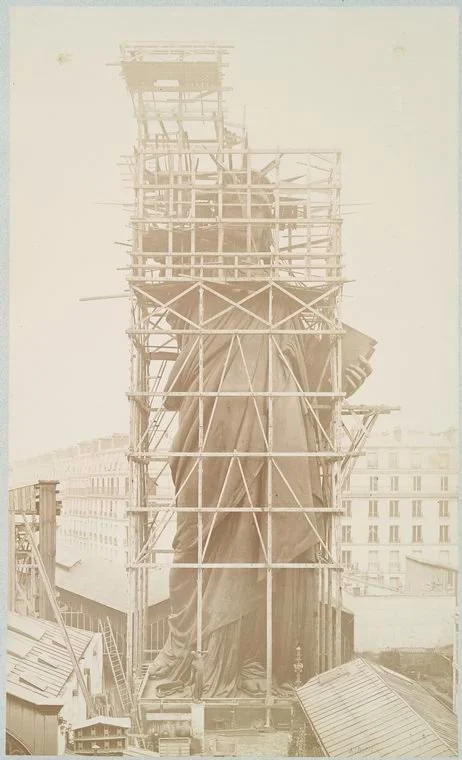
The Statue of Liberty under construction in Paris, 1883. Photograph by Albert Fernique / New York Public Library
Before anyone saw the completed statue, however, the public met Liberty in pieces.
Her arm and torch were among the first sections to be finished and crossed the Atlantic for Philadelphia's 1876 Centennial Exhibition. Visitors could climb the monumental torch, and the display helped raise money for the project.
The arm later appeared in Madison Square in New York.
Two years after Philadelphia, Liberty's enormous head and shoulders were displayed at the 1878 Paris Universal Exposition.
Historic photographs show visitors dwarfed by her face on the Champ-de-Mars. Seen now, the images are slightly surreal: one of the world's most familiar monuments appearing in fragments, years before her silhouette became instantly recognisable.
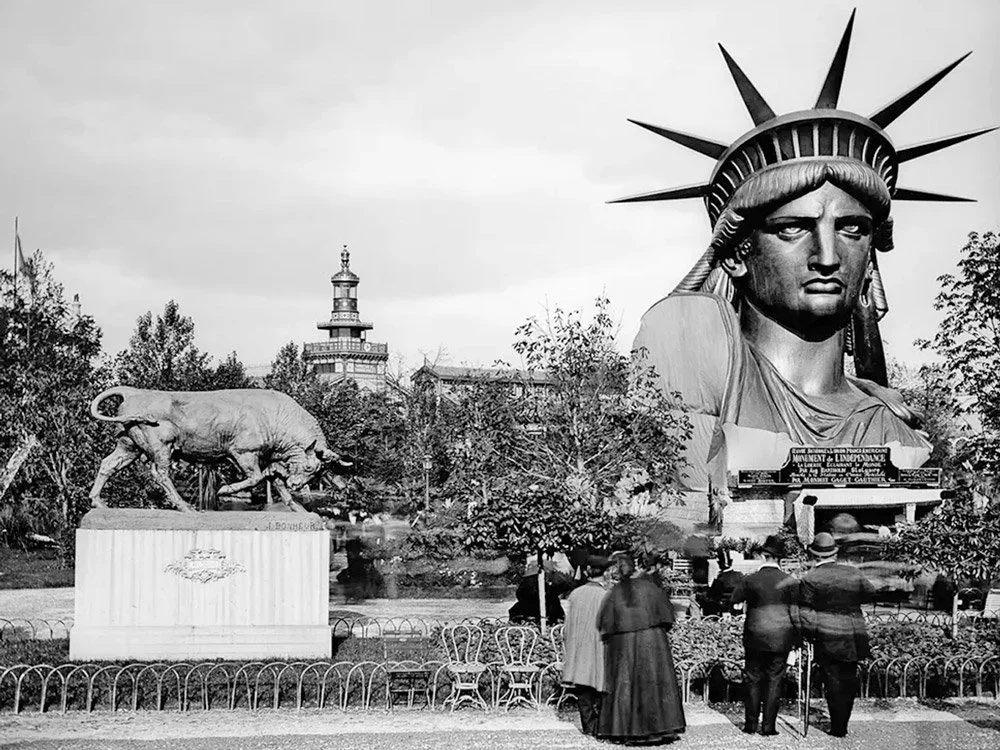
The completed head and shoulders of the Statue of Liberty on display at the Champ-de-Mars during the 1878 Paris Universal Exposition. Arcanum Paris
On July 4, 1884 hundreds gathered at the foot of the completed statue as she was formally presented to the American representative in France.
And then, after years spent building her, Paris took her apart.
Liberty was dismantled into hundreds of pieces, packed into crates and loaded aboard the French naval vessel Isère. She arrived in New York Harbor in June 1885.
America Wasn't Ready for Her
There was just one problem. America was not ready for her.
The United States had agreed to provide the pedestal, designed by architect Richard Morris Hunt, but fundraising had stalled.
Joseph Pulitzer, publisher of The New York World, stepped in and turned the stalled pedestal into a national campaign. He appealed not to industrialists or a small circle of wealthy benefactors, but directly to the newspaper's readers, promising to print the name of every donor, however modest the gift.
Pennies, dimes and dollar bills began arriving from across the country. Around 125,000 people ultimately contributed, many giving a dollar or less. By August 1885, The World had raised more than $100,000 — enough to complete the pedestal.
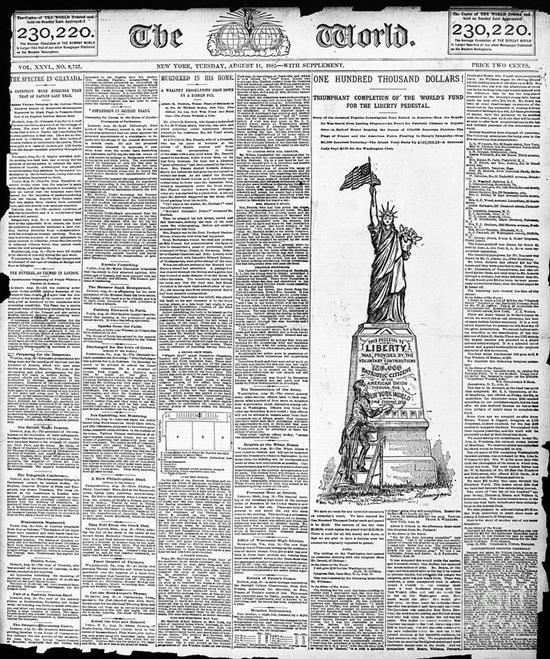
An August 1885 excerpt from The New York World announcing that its $100,000 campaign for the Statue of Liberty’s pedestal had succeeded.
France had raised the money to build Liberty. Ordinary Americans had now, quite literally, helped give her somewhere to stand.
Liberty was reassembled in New York Harbor and formally dedicated on 28 October 1886. Its official name is Liberty Enlightening the World — La Liberté éclairant le monde.
Bartholdi modelled Liberty in the classical tradition of Libertas, the Roman embodiment of freedom. Broken shackles lie at her feet, and the tablet in her arm is inscribed JULY IV MDCCLXXVI — 4 July 1776, directly tying the monument to the centennial it was conceived to celebrate.
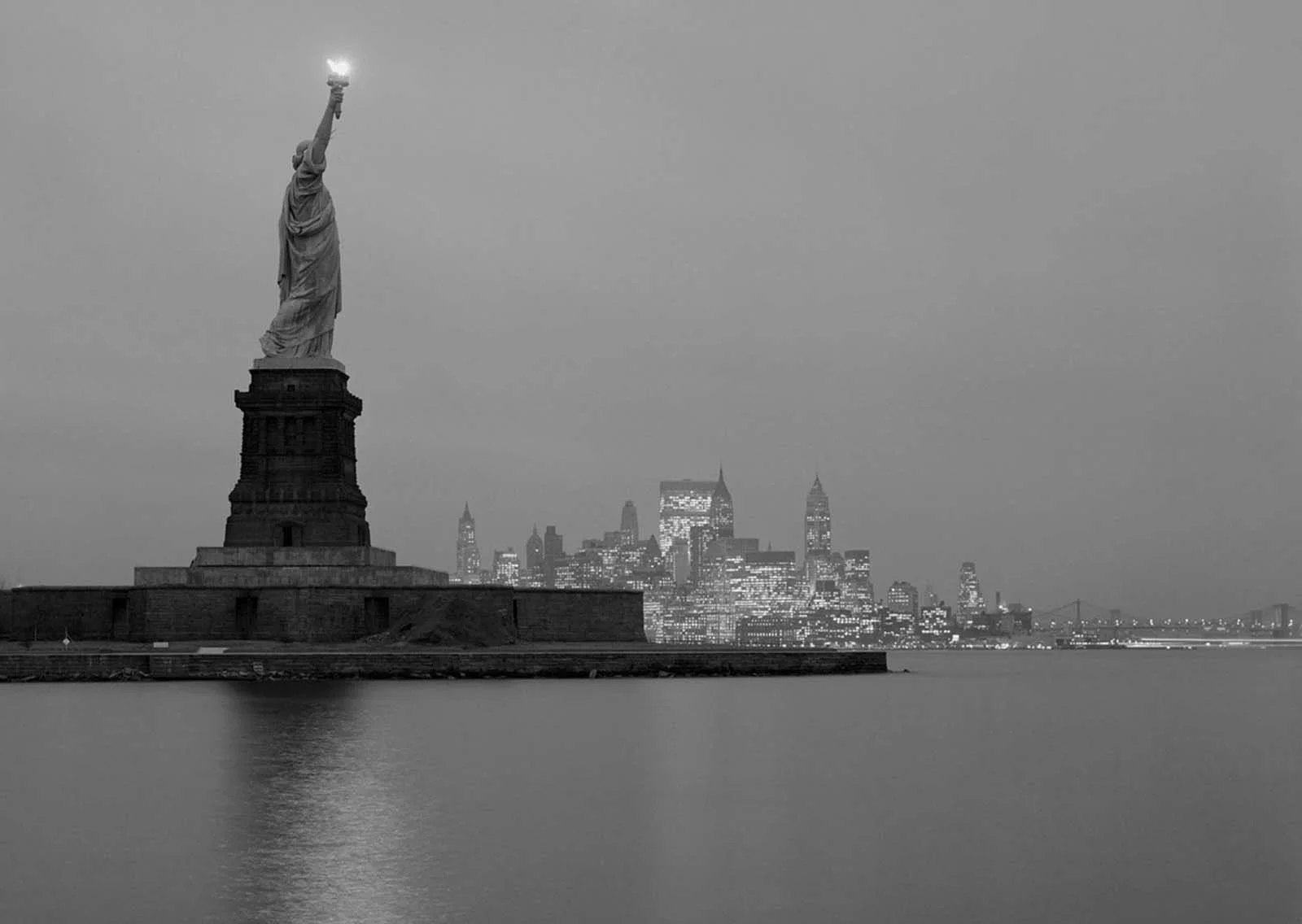
The Statue of Liberty illuminated above New York Harbor, with the Manhattan skyline beyond. Arcanum Paris
Several versions of Bartholdi’s monument remain across Paris.
The best known stands at the downstream tip of the Île aux Cygnes in the Seine. Offered to France by the American community in Paris and inaugurated on 4 July 1889, it is a bronze cast from Bartholdi’s original plaster model.
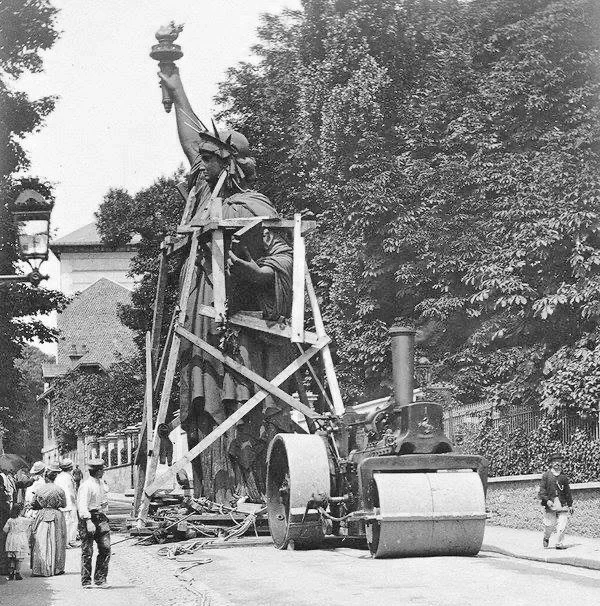
The Statue of Liberty destined for the Île aux Cygnes being transported through Paris ahead of its installation in 1889. Arcanum Paris.
Another, much smaller version was placed in the Jardin du Luxembourg in the early 20th century. The original is now at the Musée d’Orsay, while a replacement remains in the garden.
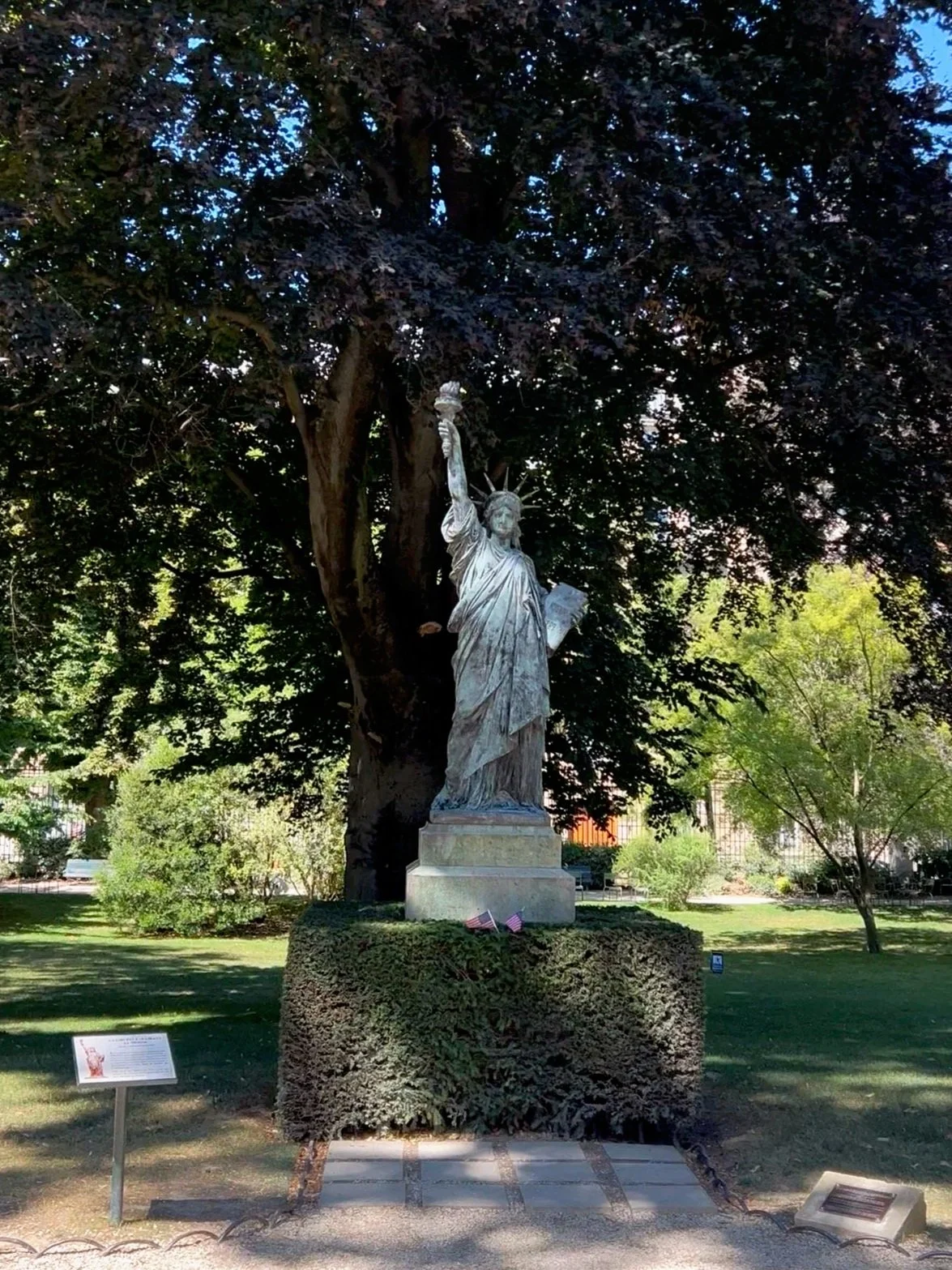
A 2.86-metre / 9.4-foot replica of Bartholdi’s Statue of Liberty in the Jardin du Luxembourg, one of six versions of the monument found across Paris. Patrycja Maka
All listing photographs belong to the listing agency.
See more on Jeudi Paris Real Estate.
Sources:
Arcanum Paris, La construction de la Statue de la Liberté à Paris;
Library of Congress, Statue of Liberty: Free to Use and Reuse;
Milk Decoration, Un atelier d’artiste parisien transformé avec brio par un collectionneur.