A Papal Fortress in Provence Turned Hotel Overlooking the Côtes du Rhône Asks €8 Million

In the 1970s the property was converted into a hotel, later operating as a Relais & Châteaux until 2023.
Beds: 25 Baths: 25 Sq Ft: ~2,000 m² (approx. 21,528 sq ft) Lot: ~24.7 acres (10 hectares / ~100,000 m²)
Amenities: Multiple reception rooms and lounges, restaurant (approx. 175 m²), seminar room, vaulted galleries, wine cellar, extensive basement spaces (~200 m²) with conversion potential, swimming pool (18m), tennis court, spa area (to renovate), outbuildings, staff accommodation, enclosed parkland with roaming deer, footbridge access, and a buildable plot with potential for up to ~16,000 sq ft (1,500 m²) of additional space.
Perched above its namesake village in the Drôme Provençale, at the northern edge of Provence, this hilltop château occupies a commanding position overlooking the Côtes du Rhône, one of France’s oldest and most established wine regions. On the market with Emile Garcin for €8,000,000, the property presents as a turnkey hospitality asset with expansion potential.
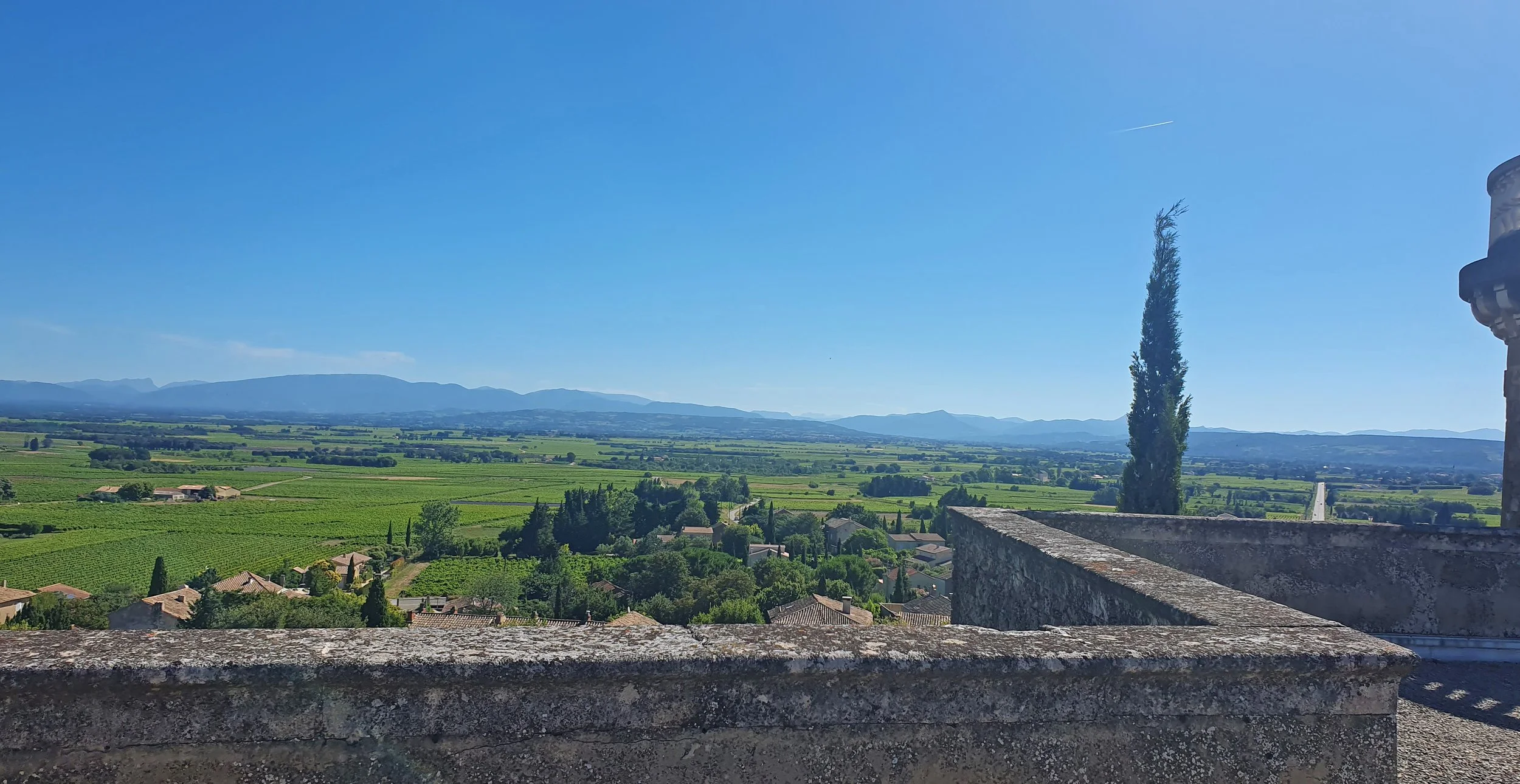
The hilltop château occupies a commanding position overlooking the Côtes du Rhône, one of France’s oldest and most established wine regions.
The site traces its origins to the Roman era, when it served as a relay point along the Via Agrippa, the arterial route linking Orange to Vaison-la-Romaine. By the 12th century, it had been fortified into a defensive stronghold, its elevated position—Rocca Acuta, or “sharp rock”—allowing for surveillance across the Rhône Valley and marking it as a frontier between Dauphiné and the papal territories of the Comtat Venaissin.
That position would define its institutional role. During the Avignon Papacy, the château was used as a site for administering justice, a function still legible today in the preserved Justice Hall. Elements of the original structure remain, including an 11th-century tower that survived the Wars of Religion, when much of the château was damaged and later rebuilt.
By the 16th century, the fortress had been reimagined as a residence by the Marquises of Rochegude, marking its transition from defensive stronghold to aristocratic estate. Subsequent interventions introduced a more refined architectural layer, with decorative gypseries reflecting 18th-century craftsmanship associated with the Petit Trianon—the private retreat of Marie Antoinette—followed by 19th-century restorations linked to Eugène Viollet-le-Duc, a leading figure in the preservation of France’s historic monuments. The result is not a singular architectural style, but a structure shaped by successive periods of adaptation, where medieval massing is layered with elements of royal-era refinement.
Today, the château is arranged around two inner courtyards and extends across four principal levels. It comprises 25 en-suite bedrooms, a series of reception rooms and vaulted galleries, and a restaurant space of approximately 175 m² (1,883 sq ft), alongside seminar and ancillary areas integrated within the historic structure. A network of vaulted basement spaces, totalling roughly 200 m² (2,153 sq ft), remains underutilized, offering scope for further conversion.
Its most recent chapter began in the 1970s, when the property was converted into a hotel, later operating as a Relais & Châteaux until 2023. The hospitality infrastructure remains largely intact, positioning the estate as a turnkey opportunity for continued operation or repositioning.
Connected by a footbridge and extending across nearly 10 hectares (24.7 acres) of enclosed, mostly wooded grounds, the estate is home to a small herd of deer that roam freely through the parkland. Additional amenities include an 18-metre swimming pool, a tennis court, and several outbuildings.
One parcel within the estate carries approved development rights, allowing for the construction of up to approximately 1,500 m² (16,000 sq ft) of additional space—a rare provision in this part of Provence, where planning constraints typically limit expansion. This introduces a layer of optionality, whether through the creation of additional guest accommodation, wellness facilities, or a complementary residential component.
Despite its setting, the château remains well connected. The A7 motorway is approximately 10 minutes away, with Avignon TGV reachable in 40 minutes and both Marseille and Lyon airports within a two-hour radius—access that has historically supported its use as both a private residence and a destination property.
In a region where many historic estates have been reduced to aesthetic propositions, Rochegude retains a more functional lineage. Its architecture remains legible as a structure of control, later adapted for residence and hospitality. That continuity, combined with its scale and permitted expansion, positions it less as a static heritage asset and more as an operational estate with multiple potential trajectories.
All photographs belong to the listing agency. See more on Emile Garcin.


All photos belong to the listing agency.