Known as Villa Balzac, this early 20th-century residence occupies a rare position directly on the shoreline of Cap d’Antibes, with uninterrupted views across the Mediterranean and private access to a small sandy beach.
Listed with Home Hunts for €17,000,000, the villa was built in 1909 as the retirement home of Émile Vaudremer, Chief Architect of the City of Paris. He is best known for several major Paris landmarks, including La Santé Prison, the Church of Saint-Pierre-de-Montrouge and Lycée Buffon.
After spending much of his career designing civic and institutional buildings, Vaudremer created this house for himself on Cap d’Antibes. It is more restrained than many Riviera villas of the period, with the architecture centred on proportion, light and its relationship with the sea.
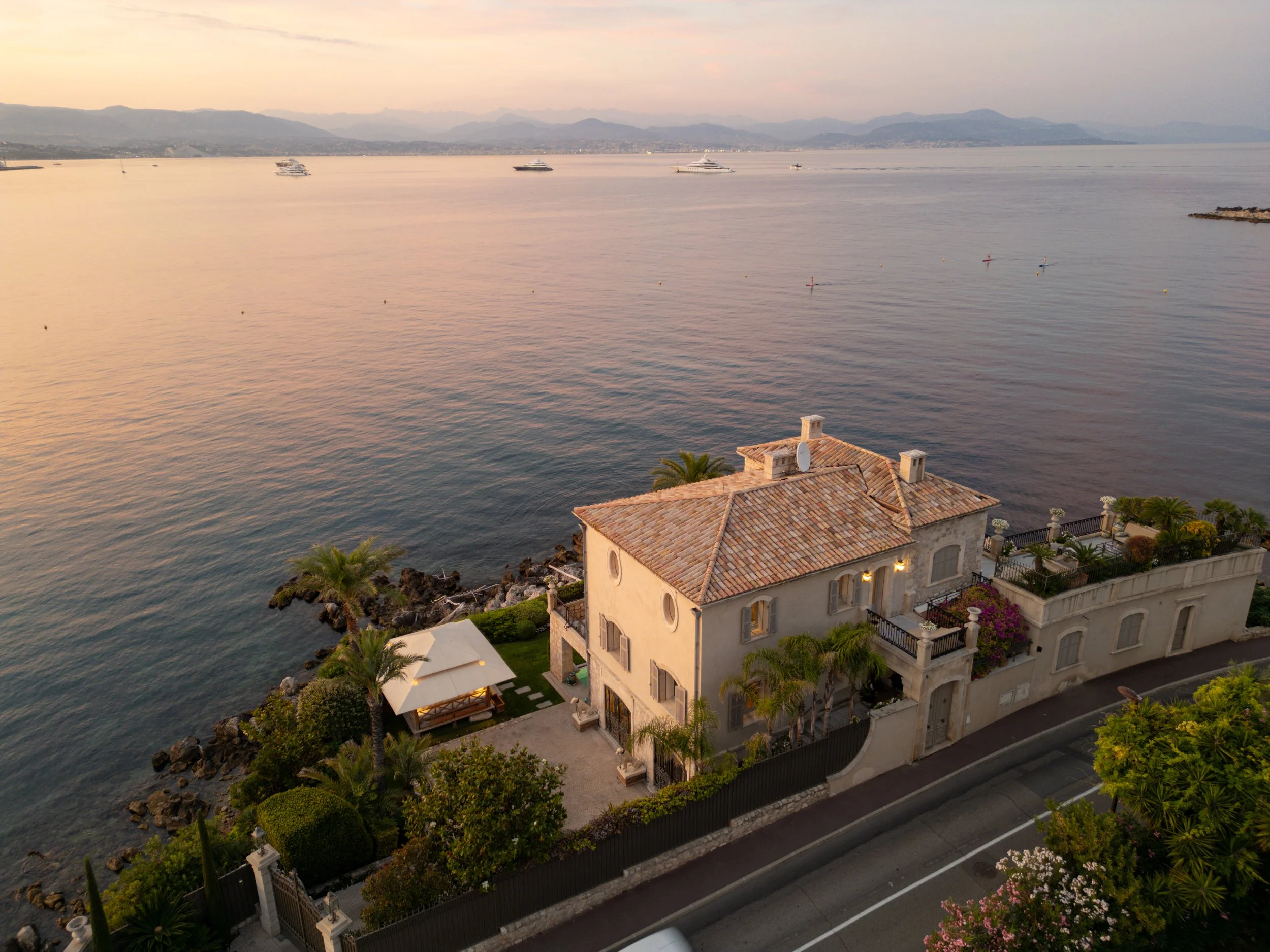
Waterfront villa on Cap d’Antibes. Home Hunts
The villa has since been comprehensively renovated for contemporary living, while retaining the generous proportions, ceiling heights and clear organization of the original residence. Its principal rooms remain oriented toward the Mediterranean, opening onto broad terraces positioned directly above the water.
The property spans approximately 466 m² (5,016 ft²) across three floors, connected by both a staircase and lift, and includes five bedrooms and five bathrooms.
On the main level, the living room opens directly onto a large sea-facing terrace. A light-filled dining room, fully fitted kitchen, office or television room and guest suite with a bathroom and dressing room complete the floor.
The upper level is centred around the primary suite, which opens onto a broad terrace with a Jacuzzi and dedicated outdoor living and dining areas. A second guest suite and an additional bedroom or office with its own bathroom are also located on this floor.
At garden level, the villa includes an independent housekeeper’s apartment, a further guest suite, laundry facilities, a double pool lounge, shower room and a dedicated wine cellar and tasting room.
The house stands within approximately 700 m² (7,535 ft²) of manicured grounds, with a further 300 m² (3,229 ft²) of sunny and shaded terraces. A heated swimming pool, covered garden cabana overlooking the sea, single garage, gated parking and integrated security complete the property.
Its defining feature, however, remains its position. Villa Balzac sits immediately above the Mediterranean and has private access to a small sandy beach—an increasingly uncommon condition along one of the most established residential stretches of the Côte d’Azur.
From most rooms, uninterrupted views extend across the bay toward Antibes, Nice and Monaco, reaching as far as Italy, with the snow-capped Alps visible beyond on clear days.

Access to a private sandy beach on Cap d’Antibes. Home Hunts
Cap d’Antibes and the Making of the French Riviera
Set between Cannes and Nice, Cap d’Antibes is a wooded peninsula extending into the Mediterranean between the historic town of Antibes and Juan-les-Pins.
Its rise formed part of the wider transformation of the French Riviera during the late 19th and early 20th centuries, when the coastline evolved from a collection of fishing communities and agricultural landscapes into an international destination for grand hotels, private villas and seasonal residences.
By the turn of the century, substantial houses and gardens had begun to appear across the peninsula, drawn by its sheltered coves, rocky shoreline and open views across the Mediterranean.
Among the most influential developments was the Grand Hôtel du Cap, now Hôtel du Cap-Eden-Roc. Originally conceived in the 19th century as a retreat for writers, it later became one of Europe’s most storied hotels and helped establish Cap d’Antibes as a destination defined by privacy, gardens and direct access to the sea.
The peninsula’s cultural mythology developed most vividly during the 1920s. American patrons Gerald and Sara Murphy spent summers on Cap d’Antibes and gathered around them a circle that included Pablo Picasso, Fernand Léger, F. Scott Fitzgerald, Ernest Hemingway and John Dos Passos.
Their presence helped turn the Riviera, previously associated largely with winter travel, into a fashionable summer destination for the international artistic and social elite.
Fitzgerald later drew on the atmosphere of the Riviera and its expatriate society in Tender Is the Night, while Picasso’s longer connection to Antibes culminated in his stay at the Château Grimaldi in 1946. The building later became the Musée Picasso, preserving a body of work created during his time in the town.
Yet the enduring appeal of Cap d’Antibes is not based on celebrity history alone. Unlike more densely developed Riviera resorts, much of the peninsula remains characterized by mature gardens, established estates and houses concealed behind walls and Mediterranean vegetation.
Many of its most significant homes reveal themselves more clearly from the sea than from the road.
Strict coastal protections, limited shoreline availability and generations of long-term private ownership have made genuine pieds-dans-l’eau properties particularly scarce. Most houses with direct access to the Mediterranean date from an earlier period, when villas could still be built in such close relationship with the coast.
Villa Balzac belongs to that history. Built in 1909 as the retirement home of one of Paris’s leading civic architects, it remains a rare example of an early seafront residence on Cap d’Antibes, retaining both its original architectural character and its direct connection to the Mediterranean.
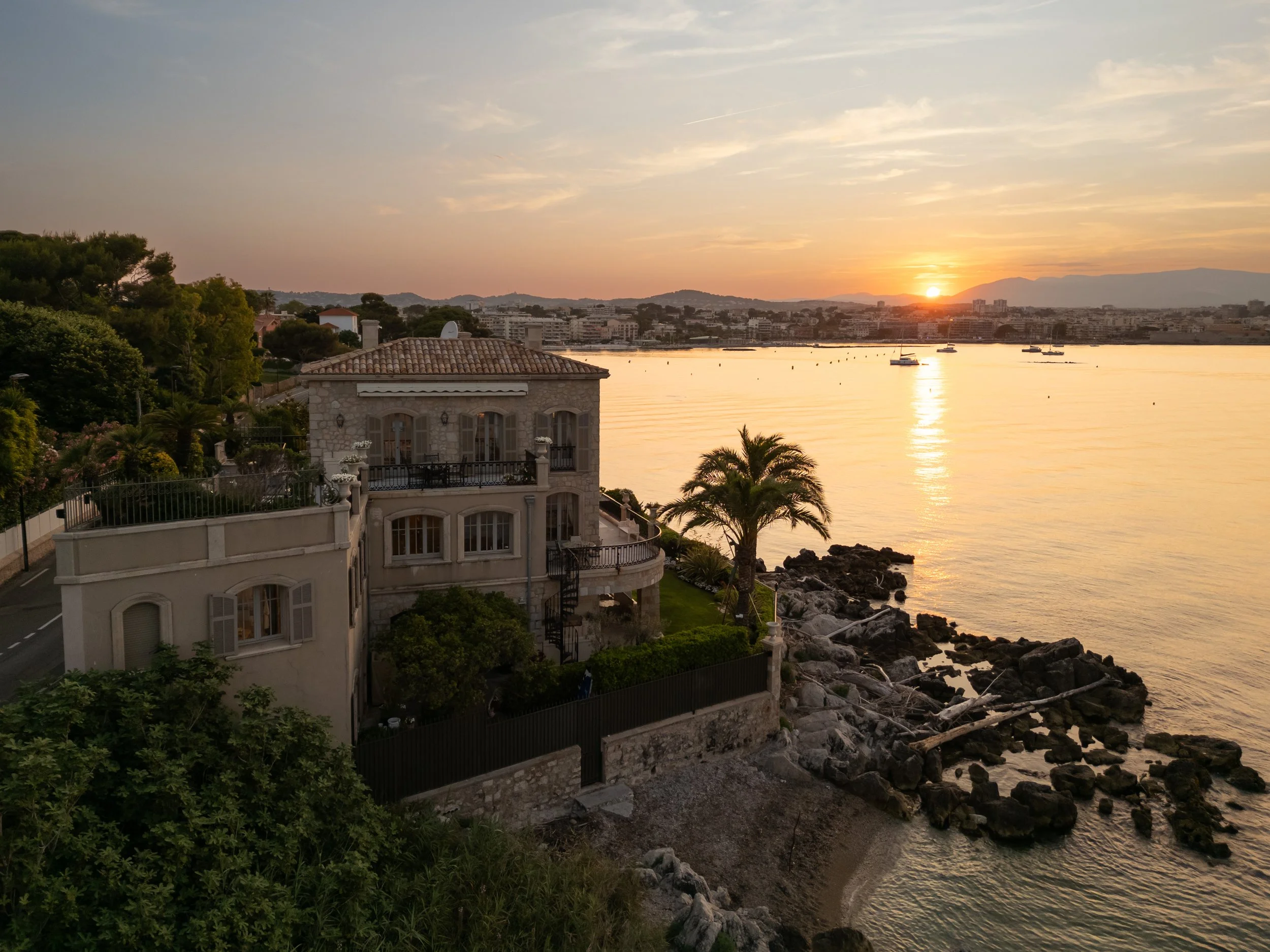
Villa Balzac was built in 1909 as the summer residence of Paris architect Émile Vaudremer. Home Hunts
All photos belong to the listing agency. See more on Home Hunts.