An Architect's NoHo Penthouse in 1893 Renaissance Revival Loft
In the 1980s, when Nasser Nakib was a junior architect working in Soho, he used to slip over to Bond Street on his lunch breaks just to stand on the cobblestones. “In Provence you’re in a lavender field and you think, I could die happy here,” he says. “In New York, this block is it for me.”
Four decades later he finally owned a piece of it. In 2016 he bought the raw top floor of 21 Bond Street—the 1893 Renaissance Revival loft building he had coveted since those early walks (early tenants included a casket company and a high-end leather factory; more recently the late artist Emma Amos kept her studio on the second floor).
Over the next eight years he turned the empty shell into the home where he raised his three sons.
Now the boys are grown and launched, and at 62 Nasser is ready to downsize. The apartment has come to market for $8,995,000, listed with Esteban Gomez of Compass.
It is the entire sixth floor of an intimate six-unit co-op: private keyed elevator landing, approximately 3,800 square feet, four bedrooms, two-and-a-half baths, and soaring 14-foot ceilings bathed in light from a dramatic 11 × 10-foot operable skylight he cut into the roof, plus three additional motorized skylights with blackout shades. Original brick walls and heavy timber beams remain proudly exposed, and the floors throughout are wide-plank Dinesen HeartOak.
The living room revolves around a grand gas fireplace built from a wooden Provençal mantel and trumeau that Nasser and his partner Julia discovered together at the Paris flea market. A 125-inch motorized screen and Sony 4K projector drop down for movie nights. The kitchen is set up for real cooking, with a full Miele suite and Rosso Verona marble counters. The south-facing primary suite has its own fireplace and a full wall of mirrored oak wardrobes, while the bathrooms deliver radiant-heated French terracotta floors and a proper cast-iron soaking tub.
The building has one residence per floor and a shared roof deck. The sale includes one-fifth ownership of the ground-floor commercial space, currently Gigi Hadid’s Guest in Residence cashmere shop.
Bond Street remains the most serene, tree-lined cobblestone block downtown—wide, impossibly quiet, and still the single most coveted address in NoHo—yet only steps from Il Buco, The Public Theater, Acne Studios, John Varvatos, and every new private club that matters.
All photos belong to the listing agency. Photography by Alejandro Leon / Represented by DD-reps.
1800s Hudson River Estate Linked to One of America’s “First Families”
On 34.5 acres with more than half a mile of Hudson River frontage, Ulster Landing is a circa-1800s Hudson River estate once held by one of America’s influential dynasties, the Livingston Family.
Ulster Landing is an estate from the 1800s located on the Hudson River, once held by one of America’s influential families. Listed for $8,350,000 with The Lillie K. Team of Four Seasons Sotheby’s International Realty, the estate spans 34.5 acres in Kingston, New York, with an impressive ½ mile of frontage on the Hudson River.
The History
The Livingston family traces its American roots to Robert Livingston the Elder (1654–1728), a Scottish immigrant who came to the British colonial Province of New York in 1674. It was in 1715 King George I of Great Britain granted Robert royal patent to 160,000 acres (650 km2/ 250 sq mi) of land along the Hudson River, making him the first Lord of Livingston Manor.
Over the next 300+ years the Livingstons would be heavily involved in the US, often referred to as one of America’s “first families” ; their legacy includes Philip Livingston, a signer of the Declaration of Independence, and Robert R. Livingston, who administered George Washington’s presidential oath of office and negotiated the Louisiana Purchase. The town of Livingston, New York was even named after the family.
Descendants of the Livingstons include Presidents of the United States George H. W. Bush and George W. Bush, First Lady of the United States Eleanor Roosevelt, and members of the Astor family.
The original 160,000 acre Livingston Manor estate would be divided between the descendants over the coming centuries, and some of the original land is still owned by descendants.
Ulster Landing
1777 Map of the original 160,000-acre Livingston Estate, located about 40–50 miles (65–80 km) north of Ulster Landing (marked in red), which is the only known Livingston property on the west side of the Hudson River.
Located in Kingston, NY, the estate is about 40–50 miles (65–80 km) south of the former Livingston Manor and is the family’s only known estate on the west side of the Hudson, underscoring its unusual place in the dynasty’s riverfront story.
Ulster Landing was purchased by the Livingstons in the early 1800s and the present-day house was rebuilt by Charles Livingston in the mid-19th century after a fire.
The estate was owned by the family until about 1970. Sometime after 2020 the present owners purchased property and updated the house infrastructure, interior and grounds, transforming and preserving the property for modern living. The owner’s, who live in New York City, stated to Bloomberg that it’s “bittersweet” to sell the home. “It’s such a cool property,” the owner stated. “But it just didn’t feel like it made sense for us anymore.”
Then and Now
Life at Ulster Landing
Archival photos courtesy of the Lillie K. Team of Four Seasons Sotheby’s International Realty.
Approached by a long, tree-lined drive bordered by wildflower meadows and immense Catalpa trees, the main house retains its distinctive facade and original millwork. The 6,900-square-foot residence includes 6 bedrooms and 7 baths. Inside, the formal living and dining rooms overlook the river with French doors that open to a wraparound porch and bluestone terrace.
The interiors balance heritage and color with a carefully considered palette. A deep red custom kitchen, crafted with a local craftsmen, anchors the home with an AGA range, elaborate millwork, and restored cabinetry. The adjoining family room contrasts in moodier tones, preserving tin ceilings and cabinetry that houses the original dumbwaiter. In the library, shelves are lined with indigo Antoinette Poisson wallpaper, while upstairs, playful Swedish stripes define the children’s suite. Even utility spaces carry character — the ochre-painted flower and laundry room, with built-in cabinetry and an oversized sink, feels designed as much for rhythm of use as for visual effect.
The second floor is divided into owner and guest wings. The vaulted primary suite opens to a balcony above the Hudson, with a fireplace and adjoining dressing room that could serve multiple functions. Its bath features a freestanding soaking tub framed by original arched windows. Across the landing, the guest wing offers vaulted suites with French-door balcony access, maintaining separation while preserving views.
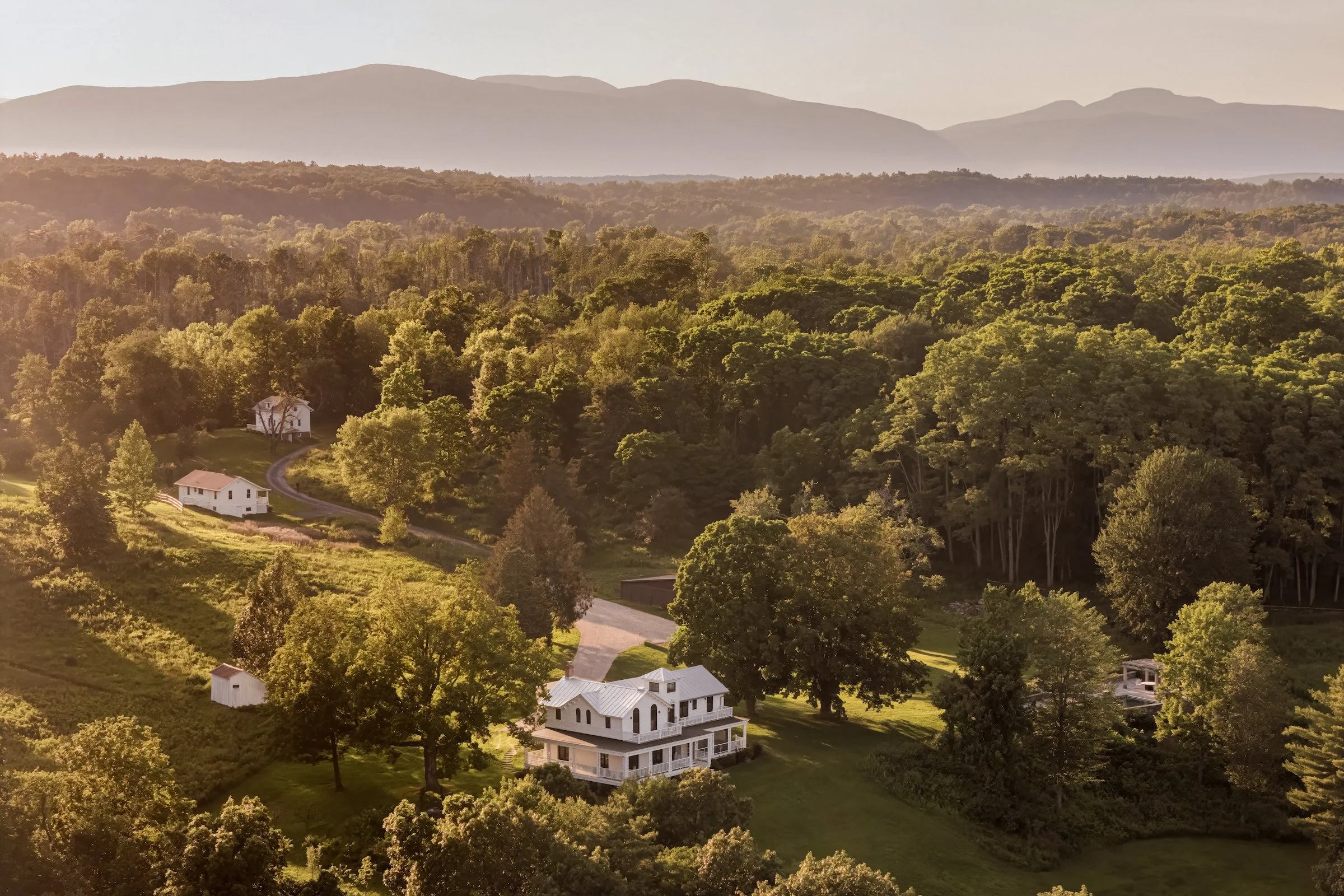
Across its 34.5 acres, the estate blends landscaped and natural elements: rolling meadows, centuries-old flowering trees, and a private pebble beach along the Hudson. A heated gunite stone pool and spa sit high above the river with a bluestone terrace, outdoor shower, and concealed storage below.
Historic outbuildings add to the property’s layered charm. A circa-1800s barn contains original carriage equipment; a mid-century Playhouse offers light-filled living space, kitchenette, and gym; and the Gatehouse, original to the estate, now serves as a one-bedroom guest cottage.
The Hudson Valley Setting
Ulster Landing lies minutes from Kingston’s historic district, with its restaurants, shops, and weekly farmers’ market. Rhinebeck, Tivoli, and Hudson are nearby cultural anchors, while the Rhinecliff Amtrak station connects directly to New York City in under two hours. Today, the combination of heritage, cultural vitality, and direct river access explains why this stretch of the mid-Hudson Valley ranks among the region’s most desirable places to live.
All photos courtesy of The Lillie K. Team of Four Seasons Sotheby’s International Realty.