
The Patiño Palace on the Portuguese Riviera

There’s the French Riviera and the Italian Riviera, but did you know there was also a Portuguese Riviera? By 1905, the coast west of Lisbon around Cascais and Estoril was being called the “Riviera de Portugal,” as it developed into a fashionable seaside retreat for royalty and international society. The area later became known as the Costa do Sol, while locals today generally call it the Linha de Cascais, or Cascais Line.
Quinta Patiño was previously offered for sale in 2021 for €23 million.
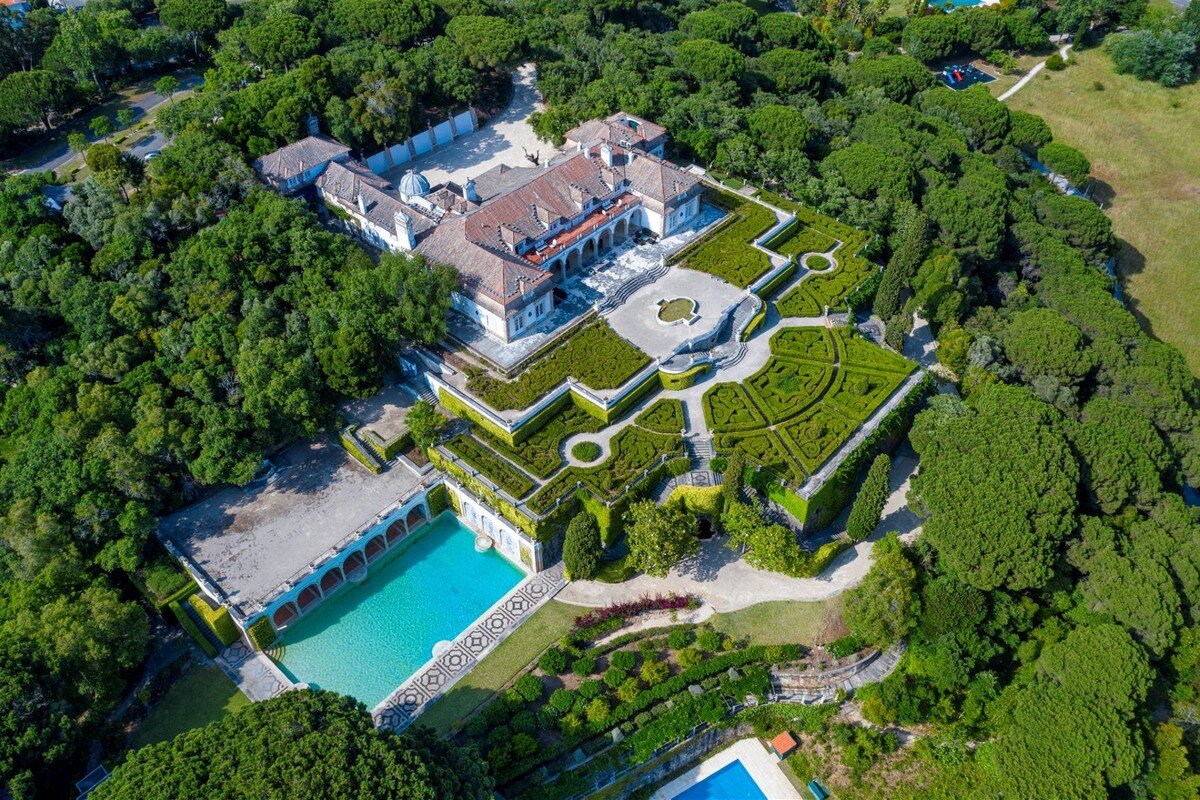
Built for Antenor and Beatriz Patiño in the hills above Estoril and Cascais, the palace stood at the centre of what was once an approximately 50-hectare (124-acre) private estate. There were formal gardens, 17th- and 18th-century Portuguese tiles, a library inspired by one of Europe’s great Baroque libraries, a private cinema, a jewellery vault, a 17th-century chapel brought down from northern Portugal stone by stone and, eventually, a single-lane bowling pavilion so elaborate that Architectural Digest devoted four pages to it.
And then there were the parties.
The Patiño Fortune
Antenor Patiño was heir to one of the great fortunes of the 20th century, although the story began very differently with his father, Simón.
Simón Patiño had an extraordinary rags-to-riches story. Working as a clerk in a miner’s supply store in Bolivia, he reportedly accepted the deed to a tin mine in settlement of a $250 debt, a decision that got him fired but put him into the tin business just as established European mines were beginning to run down. He moved his family into the Bolivian mountains, travelling by mule and spending years developing the property. Eventually, he struck an exceptionally rich lode of tin. By 1910, he was selling to Europe on a major scale, and by 1912 he reportedly had $2 million to acquire additional mines.
From there, the fortune became enormous. Simón built a mining, banking and railway empire that made him one of the richest men in the world, earning the nicknames the “Tin King” and the “Rockefeller of the Andes.” By 1924, he controlled more than half of Bolivia’s rapidly expanding tin output and was already being described internationally as the “richest man in the world.”
By 1925, his fortune was estimated at around $100 million, roughly $1.9 billion in 2026 U.S. dollars. TIME reported that he maintained no fewer than 13 châteaux around the world, including homes in Nice, Biarritz, London and Paris. His mining and smelting interests stretched from Bolivia to Malaya and Britain, and his personal income was eventually reported to exceed the revenues of the Bolivian government.
By then, the Patiños were living on a truly international scale. The family moved through a world of European houses, diplomatic posts, art collections and aristocratic marriages, and Antenor grew up inside that orbit.
His own life would become just as international. In 1931, he married María Cristina de Borbón y Bosch-Labrús, Duchess of Dúrcal and a relative of King Alfonso XIII of Spain.
They had two daughters, María Cristina and María Isabel, but by the early 1940s the marriage was already coming apart. While the couple was living in New York during the war, María Cristina sued Antenor for abandonment. They reconciled in 1944 under an extraordinary financial agreement that reportedly included a $500,000 payment and the promise of another $500,000 seven years later, but after the war Antenor returned to Paris without her.
By the late 1940s, Beatriz de Rivera was already part of his life. Beatriz was Franco-Spanish and had also been married before, to the Italian Count Giovanni Lodovico di Rovasenda. Her own background placed her comfortably within the same international social world Antenor inhabited, and the two became companions while his first marriage was still being fought through courts in France, Mexico and the United States.
The divorce became an international saga. María Cristina challenged Antenor’s Mexican divorce in France, financial claims moved between jurisdictions, and in 1952 she even had him arrested at a New York airport. Antenor finally secured a divorce that allowed him to remarry, and he and Beatriz were married in London in January 1960, both for the second time.
Together, they moved between Paris, New York and Portugal, travelling widely through Europe and the Americas and mixing easily across old European aristocracy, industrial fortunes, film, fashion and the emerging international jet set.
By then, Quinta Patiño had already become the great Portuguese setting for that life, and in 1968 they would host the legendary “Party of the Parties” there.
In 1977, Antenor and Beatriz were photographed at Studio 54 in New York sitting with Carolina Herrera, a wonderfully unexpected image of a couple just as comfortable in late-night Manhattan as they were entertaining royalty in a Portuguese palace.
Quinta Patiño and the Portuguese Riviera
In the 1950s, Antenor had begun assembling parcels of land in the hills above Estoril and Cascais, eventually creating an estate of approximately 50 hectares (124 acres) where he and Beatriz would build one of the most extraordinary private houses on the Portuguese Riviera.
By then, Quinta Patiño had already become the great Portuguese setting for that life, and in 1968 they would host the legendary “Party of the Parties” there.
The location already had its own extraordinary social history. Portugal’s neutrality during the Second World War had turned Estoril and Cascais into a refuge for displaced European royalty, aristocrats, diplomats, financiers and wealthy families. Former kings settled along the coast, while grand hotels and casinos became gathering places for an international society that arrived during what became known as the “golden exile.”
By the time Antenor began building, that world was well established. Quinta Patiño offered enough land and privacy to create a vast country estate, while Lisbon remained within easy reach and the social life of Estoril and Cascais was only minutes away. Antenor positioned the palace on elevated ground where the views were said to be most spectacular.
Building a Portuguese Palace in the 1950s
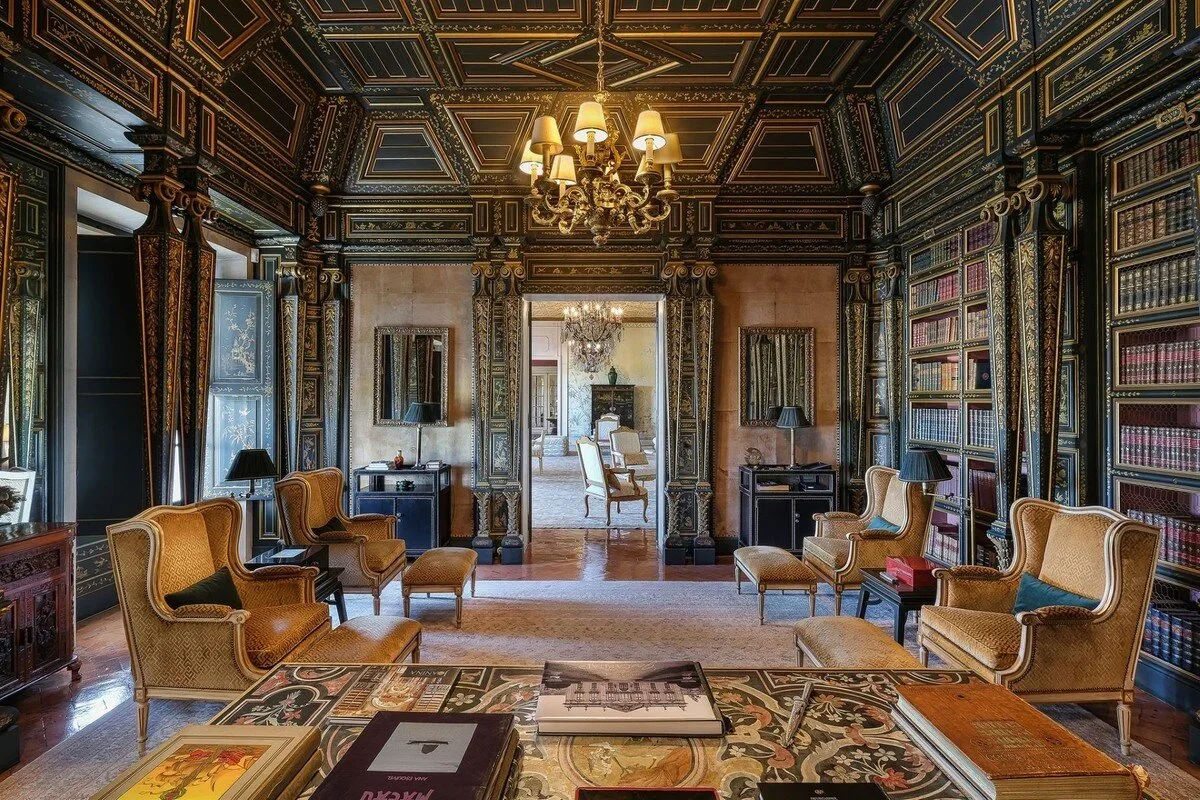
Construction began in the late 1950s, but Quinta Patiño was designed to look much older.
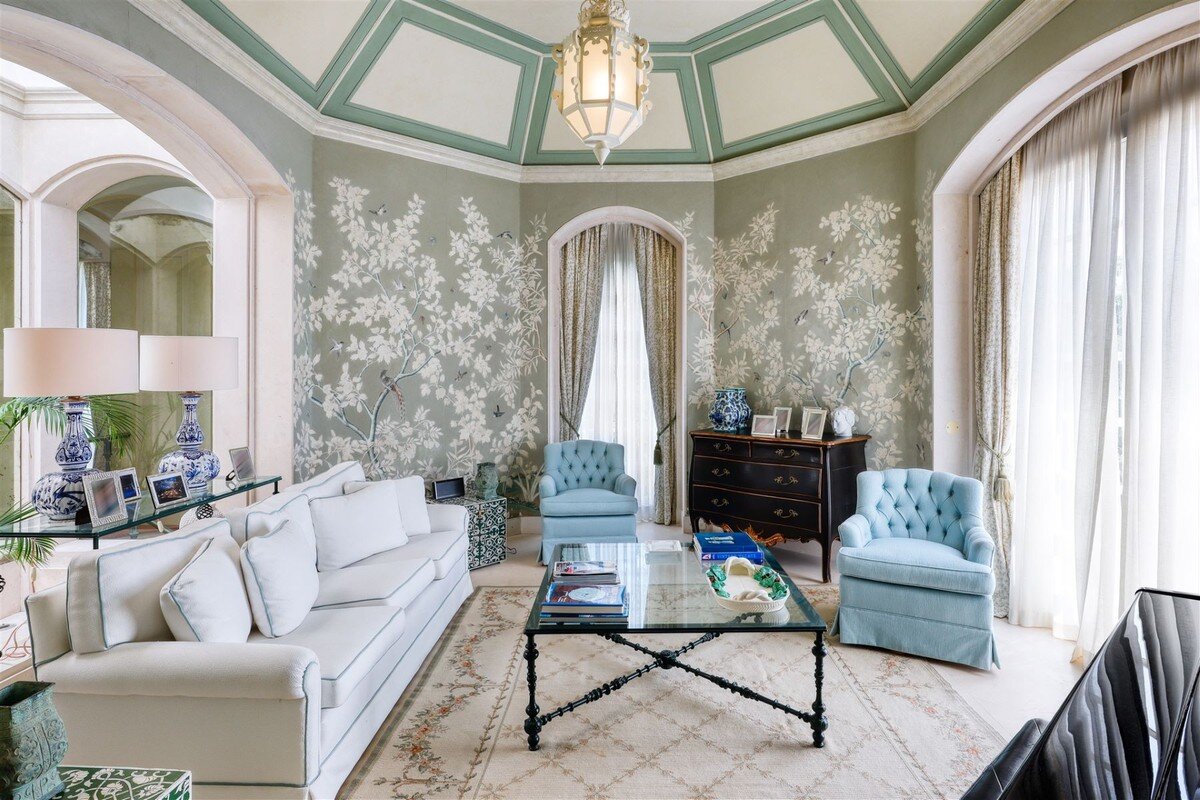
The house drew heavily from historic Portuguese architecture, with terracotta roofs, carved wooden ceilings, frescoes and extensive use of azulejos. By the time the property returned to market in 2021, the main residence extended across more than 36,000 ft² (approximately 3,345 m²), with 14 bedrooms and 17 bathrooms.
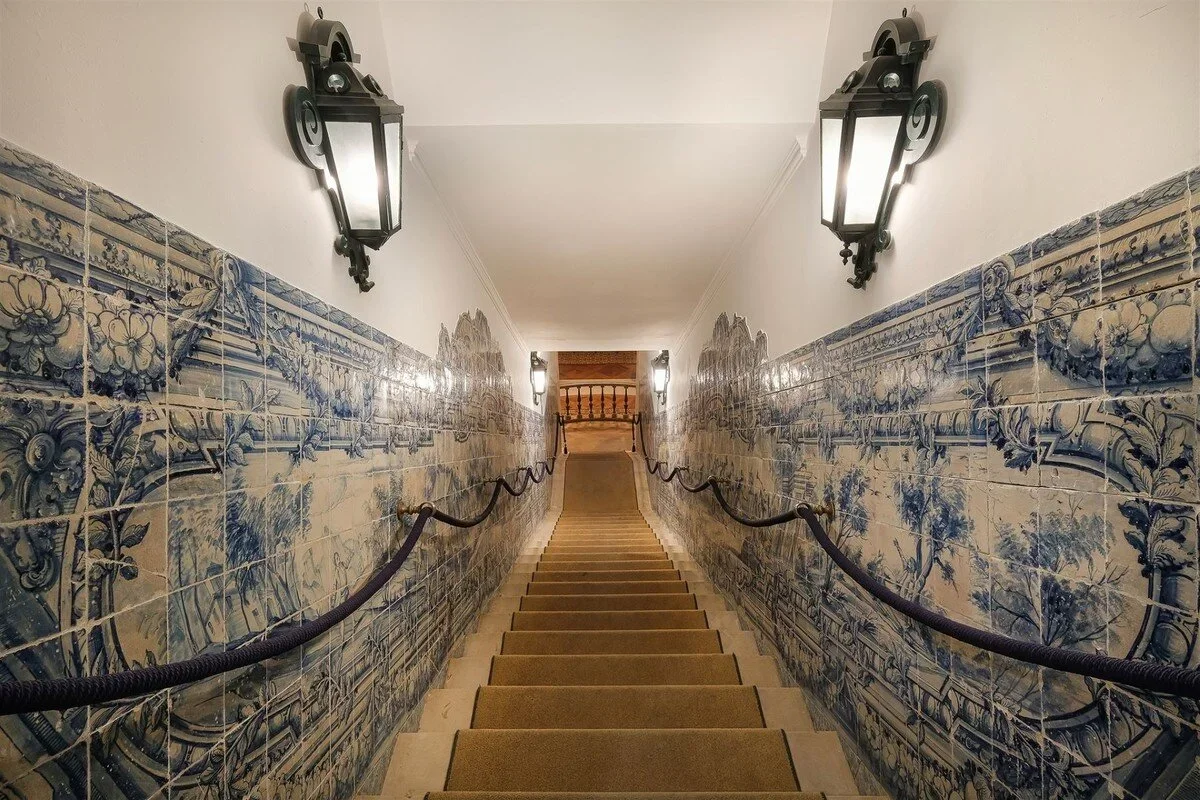
Many of the materials were genuinely historic. Portuguese tiles dating from the 17th and 18th centuries were incorporated throughout the palace, while the library was inspired by the Biblioteca Joanina at the University of Coimbra, one of Portugal’s great Baroque interiors.
Antenor also acquired a 17th-century chapel in the Minho region of northern Portugal. According to Portuguese accounts, it was dismantled, transported south and reconstructed stone by stone at Quinta Patiño.
The gardens were planned alongside the house. Between 1955 and 1958, Portuguese landscape architects Francisco Caldeira Cabral and Edgar Sampaio Fontes developed the estate’s landscape, organizing the grounds around terraces, gravel walks, clipped hedges, balustrades, ornamental urns and formal planting.
Inside Quinta Patiño
In August 1968, just weeks before the Patiños’ most famous party, Horst P. Horst photographed Quinta Patiño for Vogue.
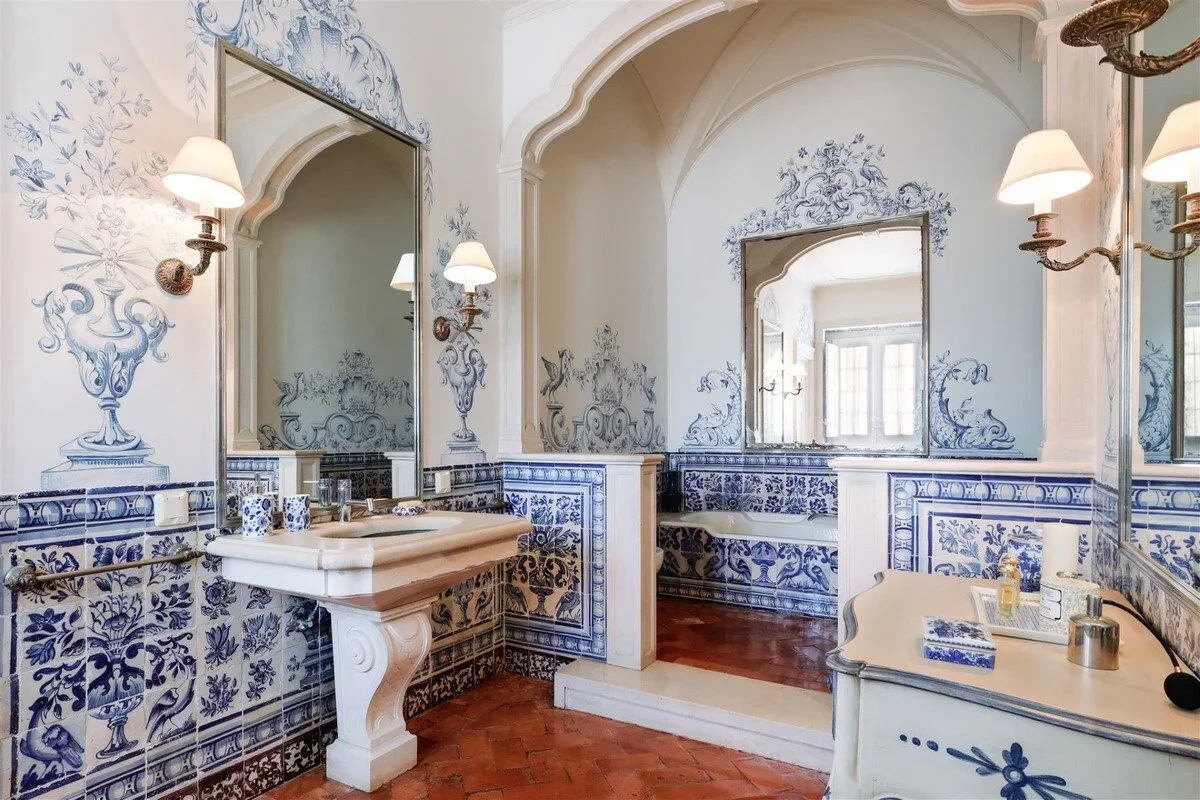
The feature captured Beatriz’s bedroom with its cream-canopied bed, Louis XV furniture and blue-and-white Portuguese landscape tiles, while the salon mixed tapestries depicting scenes from Don Quixote with 18th-century French chairs, a 17th-century cabinet and a gilded rhinoceros clock on the mantel.
One bathroom combined blue floral tiles with painted Baroque urns, vines and dolphins. Elsewhere, paneled rooms were hung with works by artists including Rembrandt and Holbein. Beatriz herself was just as memorable. One reporter described seeing her wearing a diamond necklace so brilliant that it should have been viewed “through smoked glass.”
Horst also photographed the family using the house: Antenor with his grandchildren, children around the pool, Beatriz in the gardens and members of the household staff at the ivy-covered windows. A few weeks later, more than 1,000 guests would arrive for the 1968 “Party of the Parties.”

PRIVATE COLLECTION OF THE DUCHESS OF CADAVAL
The 1968 “Party of the Parties”
By the summer of 1968, international society was already preparing for September in Portugal.
Two enormous parties were planned within days of one another. Pierre and São Schlumberger would host one at Quinta do Vinagre in nearby Colares, with Antenor and Beatriz Patiño following at Quinta Patiño. Contemporary reports described guests chartering yachts and private aircraft, booking hairdressers and ordering new gowns ahead of the weekend.
The Schlumbergers entertained first. Two nights later, on September 6, the gates of Quinta Patiño opened to more than 1,000 guests. Audrey Hepburn was there, along with Gina Lollobrigida and Zsa Zsa Gabor. Crown Prince Harald of Norway, now King Harald V, attended, as did members of the Rothschild, Rockefeller and Niarchos families and a long list of European royalty, industrialists and international society.

A “who’s who” of the 1968 Patiño Ball guest list, bringing together royalty, film stars, designers, industrialists and international society at Quinta Patiño.
Portuguese journalist João Coito later called it the most fabulous party ever held in Portugal. For the occasion, Valerian Rybar and Jean-François Daigre reportedly covered the estate’s gravel paths with lobster-red carpeting so that more than a thousand guests could cross the gardens without destroying their evening shoes.
Even the security became part of the story. According to a later account, around 30 members of Portugal’s secret police were assigned to monitor the gathering and traded their normal appearance for smoking jackets so they could blend in with the guests.
The political timing was extraordinary. Prime Minister António de Oliveira Salazar was seriously ill in hospital, and news of his condition circulated among government officials and diplomats even as the party continued at Quinta Patiño. His illness would effectively bring an end to his rule, and six years later the Carnation Revolution would end Portugal’s dictatorship. Society writer Taki later joked that the Patiño party “probably had a lot to do with the subsequent Portuguese military uprising.”
Antenor Patiño in Mexico
Quinta Patiño was not Antenor’s only ambitious project during these years. He became heavily involved in tourism and real estate development in Mexico, where he was among the early developers to recognize the potential of the Pacific coast around Manzanillo.
By the 1960s, even the international jet set was apparently growing tired of returning to the same resorts in Europe. A later Los Angeles Times account described the idea behind Antenor’s Las Hadas resort in wonderfully simple terms: he wanted somewhere new for himself and his friends.
Las Hadas grew into an elaborate whitewashed resort overlooking the Pacific, with domes, towers, villas and winding cobbled streets climbing the hillside. There was an 18-hole golf course, a marina large enough for 120 yachts and thousands of palms, bougainvillea and hibiscus planted across the property. The project reportedly cost around $33 million at the time, and Antenor helped support some of the infrastructure needed to bring international travellers into the region. Las Hadas later became famous around the world after appearing in the 1979 film 10.
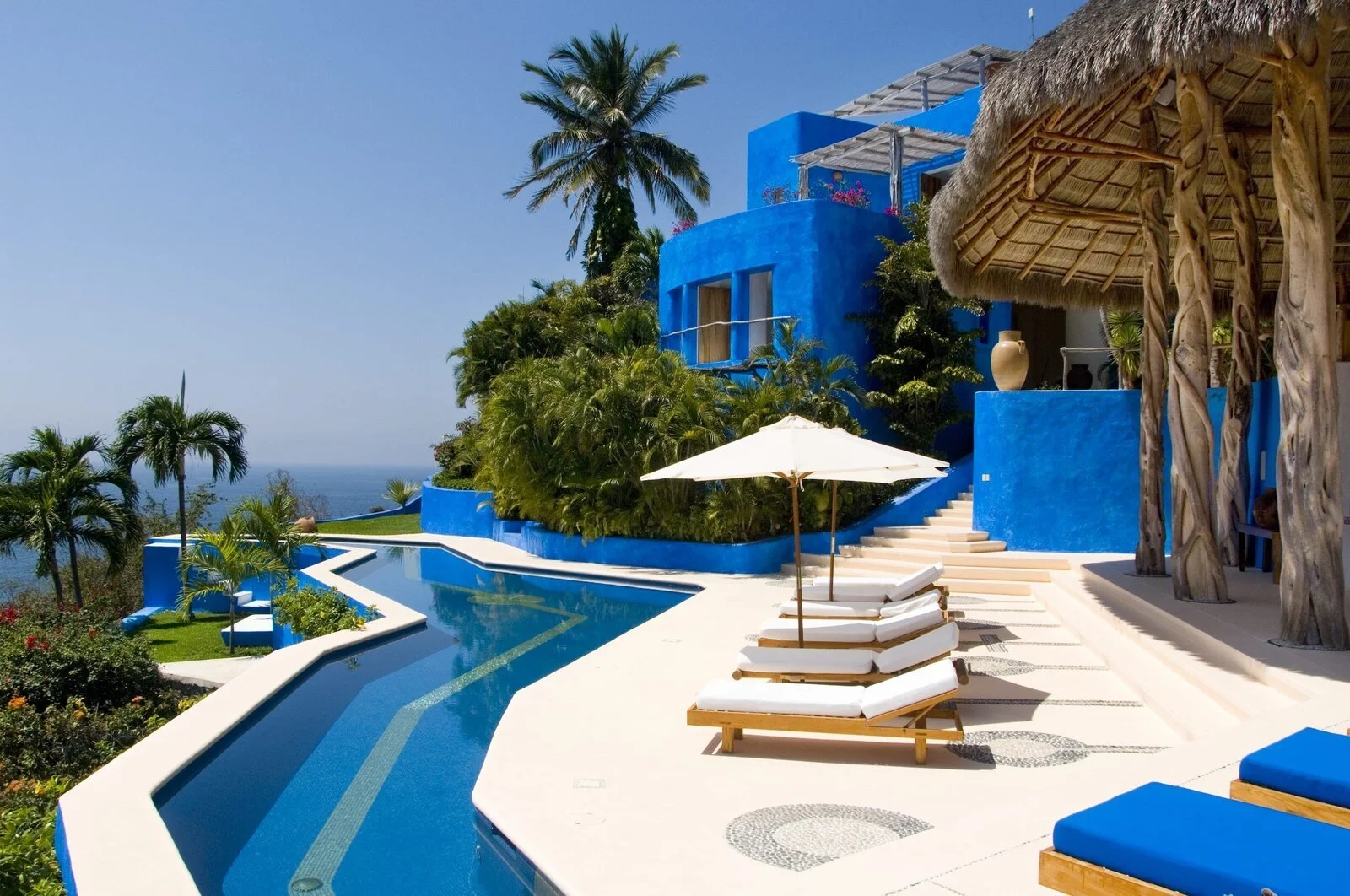
Careyes’ distinctive architectural language was shaped by Gianfranco Brignone’s vision and brought to life by architects including Alberto Mazzoni, Marco Aldaco, Jean-Claude Galibert and Diego Villaseñor, combining vivid color, sculptural forms and rustic simplicity with the landscape of Mexico’s Pacific coast. Carayes
His influence can still be traced farther up the coast. Gian Franco Brignone, the Italian financier who founded Careyes, was connected to the Patiños through his wife, a niece of Beatriz. Brignone knew Antenor in Paris and later recalled Antenor repeatedly encouraging him to come to Mexico because something interesting was happening there. He finally visited in 1968, explored the still largely undeveloped Pacific coastline and began acquiring the land that became Careyes.
More than 50 years later, Careyes remains one of the most distinctive luxury communities on the Mexican Pacific, known for its brightly coloured cliffside architecture, private houses, polo, art and international community. The Brignone family is still behind it today.
The Patiño connection continued through Antenor’s own family. His daughter María Isabel married British financier James Goldsmith, and their daughter, Isabel Goldsmith-Patiño, later took over another piece of land Antenor had intended to develop in Mexico. His plans had included a golf course and condominiums, but Isabel chose instead to preserve much of the landscape and created Las Alamandas, a small private hotel surrounded by a much larger natural reserve.
Long before Careyes became Careyes, or this stretch of Mexico became synonymous with secluded luxury, Antenor was already helping bring international attention to the region.
A Bowling Alley, Patiño Style
Back in Portugal, Quinta Patiño continued to evolve. In the early 1970s, Valerian Rybar returned to design a private bowling pavilion on the estate, which Architectural Digest devoted four pages to in 1973.
The pavilion had a single electric Brunswick lane set inside an elaborate interpretation of Portuguese architecture, with scalloped windows, vaulted ceilings and twisted-rope plasterwork inspired by the country’s Manueline tradition. Rybar treated it more like a salon than a recreation room, with spectator benches lining the lane and surrounding seating areas furnished with sofas, armchairs, carpets and pieces from the Paris decorating house Jansen.
The rope motif used in the plasterwork was repeated in the piping on the sofas and benches, woven into the carpets and even carried through to the legs of the easel holding the chalk scoreboard. At Quinta Patiño, even bowling required interior decoration.
Life at Quinta Patiño
The rest of the estate was equipped on a similarly extravagant scale. There was a private cinema with its original 1960s projector, a sauna and steam room, massage facilities and a secure vault built for Beatriz’s jewellery.
The ground-floor reception rooms opened directly onto terraces overlooking the formal gardens. A tea pavilion stood within the grounds, while the expansive swimming pool was surrounded by a loggia. For all the scale of the entertaining, Quinta Patiño remained a family summer house, with Antenor and Beatriz continuing to return to Portugal while maintaining their other international residences.
Antenor died in New York in 1982 and was brought back to Quinta Patiño, where he was buried in the 17th-century chapel he had transported from northern Portugal and reconstructed on the estate. He remained there for approximately six years.
What Happened to Quinta Patiño?
In 1988, Beatriz sold the wider Quinta Patiño estate to a group linked to Banco Espírito Santo. Antenor’s remains were removed from the chapel and transferred to the Patiño family mausoleum in Bolivia, while the approximately 50-hectare (124-acre) property entered a very different chapter.
Much of the land was divided and developed into Quinta Patiño, the private gated residential enclave that still carries the family name and remains one of the most exclusive addresses in the Cascais region.
Beatriz did not leave the landscape entirely. She retained a private parcel beside the original palace, where she later commissioned a smaller residence for herself that carried many of the architectural ideas of Quinta Patiño into a more private setting. The house became known locally as “the widow’s house” and is today known as Quinta Beatriz.
The original palace remained.





All photos belong to the original listing agency, Portugal Sotheby’s International Realty.