15th Century Priors Hall with Formal Gardens
Set in 22 acres of bucolic grounds in the Malvern Hills Area of Outstanding Natural Beauty, the Grade II*-listed Little Malvern Court offers stunning views over the Severn Valley.
Originally attached to the 12th Century Benedictine Priory, this architectural marvel offers a glimpse into the past with its impressive Romanesque church tower and medieval oak roof.
The Victorian additions, designed by renowned architect Joseph Hansom, add a touch of Gothic Revival charm.
Owned by the same family since 1530, the property was beautifully restored in the late 20th century, updated for modern day living while preserving its incredible period details, like a secret chapel hidden in the medieval oak roof of the Priors Hall, and secret rooms, concealed by beautiful panelling in the tower.
Little Malvern Court has 6 bedrooms and several reception rooms, and the kitchen and breakfast room is joined to the dining room by double doors which create an open layout.
The property benefits from lovely views over the gardens and grounds from the bedrooms and reception rooms, and there’s also a lovely patio running the length of the house perfectly positioned to showcase those views.
Surrounded by 10 acres of parkland, the property also boasts incredible formal gardens including a walled garden with a glasshouse, a rose garden and a water garden.
The estate includes 2 cottages, available as part of Lot 1. The sale presents an incredible opportunity to own a piece of history and create your own chapter in the story of Priors Hall.
The nearby Victorian spa town of Malvern offers cultural attractions, excellent schools, and a vibrant community. Worcester, with its shopping and recreational facilities, is also within reach.
And if you're in the mood for more excitement, Cheltenham is just a short drive away.
All photos belong to the listing agency.
Historic Italian Villa in the Tuscan Countryside North of Florence
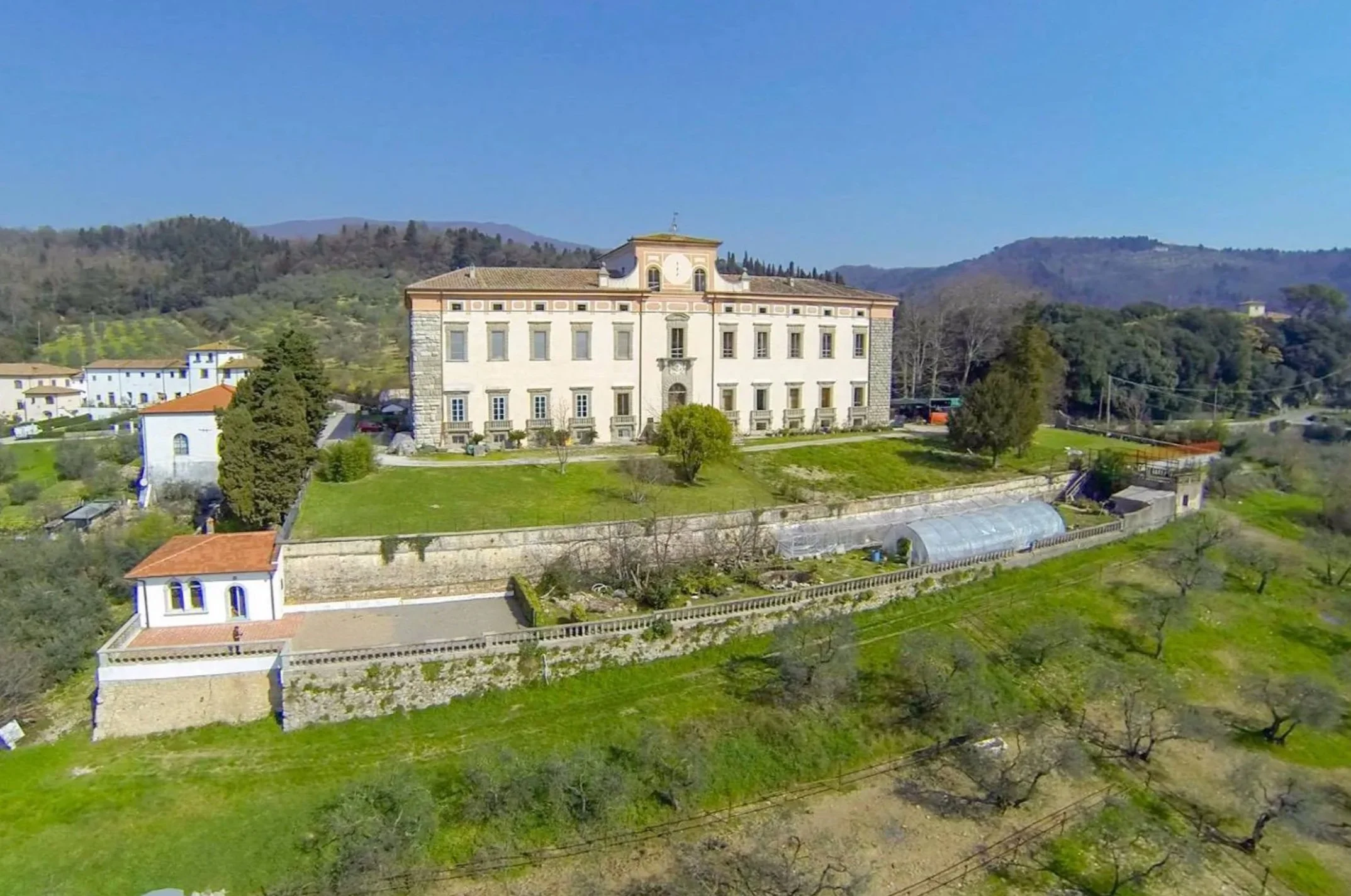
Nestled in the Tuscan countryside near Montemurlo, this restored 16th century villa awaits the next chapter in history.
Nestled in the Tuscan countryside near Montemurlo, this 16th century villa awaits the next chapter in history.
The story of this villa begins in the 15th century when the land belonged to the influential Valori family of Florence.
The Valori family steadily expanded their holdings, reflecting their rising status within Florentine society.
By around 1530, Bartolomeo di Filippo Valori took the bold step of building the villa practically from scratch, creating a structure that was unusually monumental for the Florentine territory.
This grand design was intended to serve a primarily representative function, a testament to the family's power and influence.
The villa's grandeur did not go unnoticed. Benedetto Varchi described it as a "more than royal villa," a sentiment echoed by Giorgio Vasari the Younger, who, in 1598, included a plan of the villa among the most important buildings of his time.
The building itself reflected the extraordinary success of the Valori family at the Medici court, particularly under Popes Leo X and Clement VII.
Their fortunes were further elevated by their involvement in the siege of Florence, after which Baccio Valori was appointed governor of the recaptured city.
In 1546, the estate passed to the Panciatichi family, who initiated early reconstruction efforts. By 1557, it became the residence of Giovan Girolamo de' Rossi, the bishop of Pavia and former governor of Rome. The Rossi family maintained ownership until 1693, when Francesco Tempi acquired the villa, elevating it to a marquisate in 1714.
Under the Tempi family, significant modernization took place, including architectural enhancements by Anton Maria Ferri and garden redesigns by Alessandro Saller. The villa remained in the Tempi family until 1770, when it passed to Ferdinando Marzi-Medici, who adopted the Tempi name to retain the marquisate.
In 1847, the villa was inherited by Maria Ottavia Vettori Guerrini, a cultured figure linked to the Macchiaiolo painter Cristiano Banti. However, by the late 1930s, the villa had fallen into disrepair under the Coppedè family, suffering from structural issues, theft, and vandalism.
The villa's revival began in the 21st century when a notable family of industrialists from Prato purchased and restored the estate.
Today, this 16th-century villa remains a stunning example of Renaissance architecture, preserved with care and attention to detail.
The large "U" shaped structure, with its grand façade framed by two ashlar bands, continues to impress visitors with its elegant symmetry.
The interiors, featuring late Baroque stucco work, neoclassical decorations, and rooms adorned with frescoes, evoke the splendor of a bygone era.
Surrounded by a romantic park with the remnants of an 18th-century nymphaeum and neo-Egyptian elements, the villa offers a serene retreat in the heart of Tuscany.
With approximately 30 bedrooms, 40 bathrooms, and expansive grounds, the estate is as versatile as it is beautiful, ready to be adapted for a variety of uses.
Recent restoration work has ensured that the villa's historic charm is preserved, along with structural reinforcements and a new roof.
Whether as a private residence or a prestigious venue, this villa offers a timeless elegance that is truly unmatched.
All photos belong to the listing agency.
Enchanting French Bastide and Country Estate in Provence
A dream French property for sale, Emile Garcin presents a once-in-a-lifetime opportunity with this 18th century high society retreat in the heart of Provence.
This property was listed exclusively with Emile Garcin and has been sold.
This dream French property for sale presents a once-in-a-lifetime opportunity to own a significant, 47-acre estate in the heart of Provence with 44 acres of olive groves.
With its symmetrical facade and elegant grounds with formal gardens and an esplanade of century-old plane trees, it's not hard to imagine that this French bastide was once a high society retreat in Provence.
Offering an abundance of period charm, the 8-bedroom manor house offers 6458 sq ft of living space across 3 levels, the French bastide pesents enormous potential to restore into an chic country retreat in Provence.
Several large reception rooms open out onto the surrounding terraces and grounds, featuring a vegetable garden bordered by low hedges, a beautiful swimming pool with natural filtration, and a pool house with outdoor kitchen.
Outbuildings on the property include a barn, a 2-bedroom caretaker’s lodge, garages, and an orangerie.
The French country estate is located near the charming village of Boulbon, nestled in the heart of Provence and renowned for its cobbled, cream-coloured streets and a fortified chateau which dominates the village.
Just a short 15-minute drive to the vibrant town of Saint-Rémy-de-Provence and the TGV station in Avignon, you'll have seamless access to a world of cultural experiences, and can reach Paris by train in under 3 hours.
The international airport of Marseille Provence is 1 hour away, making travel a breeze.
All photos belong to the listing agency.
Restored 16th Century Venetian Villa in the Italian Countryside
Built as a luxurious country retreat for the illustrious noble family, the villa was designed with the same Renaissant proportions and grandeur as the iconic palazzi lining Venice's Grand Canal.
This magnificent property, known as La Morosina, is not just a home; it's a living testament to the grandeur of Renaissance architecture and the opulent lifestyle of Venice's noble families,
This villa, dating back to the mid-16th century, was built as a luxurious country retreat in the picturesque countryside, set within the province of Treviso in the Veneto region.
Its design reflects the same proportions and grandeur as the iconic palazzi lining Venice's Grand Canal, offering a rare opportunity to own a piece of Venetian heritage outside the city's bustling streets.
La Morosina, with its classical Venetian architecture, was originally built for the illustrious Morosini family, a noble lineage that produced four Doges for the Republic of Venice between 1142 and 1688.
The restoration of La Morosina has been overseen by the 'Belle-Arte di Venezia,' ensuring that every step of the process honored the villa's historical integrity. Original materials were used wherever possible, and modern structural knowledge was applied discreetly to enhance the building's longevity.
The result is a property that seamlessly blends the charm of the Renaissance with the comforts of the 21st century, featuring an untouched aesthetic that has retained the patina & soft feeling desired by the present owner, and large windows and high ceilings that create an airy and inviting atmosphere.
The Italian villa boasts a striking south-facing atrium, which boasts two majestic columns made of Istrian stone.
The 'piano nobile,' the principal floor, is adorned with a large balcony and a 'Serliana'—a triple-arched window—crafted from the same exquisite stone, complete with Ionic capitals that finish the colonnade.
The original 16th-century marble fireplace still graces one of the rooms, a reminder of the villa's storied past.
The villa offers a generous floor area of 7266 square feet (675 square meters), with four spacious bedrooms and two bathrooms.
The top floor, known as the 'Piano Superiore,' is an expansive open space, flooded with light from 16 windows that offer breathtaking views of the Dolomite mountains and the surrounding countryside.
This versatile space, currently used as an artist's studio, could easily be divided to create additional living areas if desired.
Set within 11 acres of grounds, the villa is surrounded by organic vineyards and farmland, providing a serene and private retreat.
The formal garden, designed to reflect the proportions of the villa, is planted with flowers, herbs, and citrus trees, creating a lush, aromatic environment. The avenue leading to the lake is lined with walnut trees and lavender, while bamboo and weeping willows add a touch of whimsy to the landscape.
Wildlife abounds in this idyllic setting, with turtles, frogs, hares, and hedgehogs frequently spotted around the lake and gardens. The villa's well still pumps water year-round, ensuring the gardens remain lush and vibrant even in the height of summer.
Despite its secluded location, La Morosina is conveniently situated just 5 kilometers from the town of Motta di Livenza, where you can enjoy local markets, fine dining, and a range of amenities. Venice, with its rich cultural heritage, is only a 40-50 minute train ride away, making it easy to immerse yourself in the vibrant life of one of Italy's most iconic cities.
Whether you're seeking a luxurious family home, a serene retreat, or a statement property with historical significance, this 16th-century villa is a rare gem that promises a lifestyle of elegance, privacy, and cultural richness.
With its impeccable restoration, rich history, and stunning surroundings, La Morosina is more than just a villa—it's a gateway to the timeless beauty and sophistication of the Venetian Renaissance.
All photos belong to the listing agency.
Restored French Bastide and 17-Acre Estate Near Bonnieux, Provence
Lush and romantic, this dreamy French bastide is surrounded by award-winning Mediterranean gardens, just a short drive from the villages of Gordes, Lourmarin, Bonnieux, Roussillon, Menerbes and Lacoste.
Located near the authentic Provencal village of Bonnieux, one of the most beautiful villages in France, the dreamy property dates back to the 15th and 17th centuries, set in the heart of a 17 acre woodland estate.
The 7 bedroom bastide for sale boasts original vaulted ceilings and grand, formal living spaces which open out onto the surrounding terraces, complete with a large swimming pool and outdoor kitchen.
Lush and romantic, this dreamy French bastide is surrounded by award-winning Mediterranean gardens and offers views over the Luberon parkland.
The French country estate is a short drive from Provence's top attractions, nearby the villages of Gordes, Lourmarin, Bonnieux, Roussillon, Menerbes and Lacoste.
All photos belong to the listing agency.
This 16th Century Tuscan Villa Was Once The Home of The Mona Lisa
Accessible by a long cypress-lined driveway, this gorgeous hilltop villa is located just 3 miles from Florence, set in the infamous Tuscan wine region of Chianti.
Luxurious in size and style, the villa is spread across three levels with elegant living rooms, kitchens, 14 bedrooms including one with a panoramic veranda, 15 bathrooms, a library, a gym, and a large terrace in the clocktower with views of the Florence plain.
The historic villa has been restored over the years and features fine period detail throughout its 30,000 square feet of interior space.
The villa is set in 66 acres of parkland with tree-lined alleys, vineyards and olive groves - there’s also a lemon conservatory, in addition to various outbuildings. The property also includes a tennis court and a swimming pool.
But what truly sets this villa apart is its historic pedigree.
The property’s fascinating history predates even this incredible cultural reference: in the 14th century its resident was Baldo d’Auguglione, who was involved in the exile of the poet philosopher, Dante, from Florence —he was cited twice as the villain in Dante’s Divine Comedy.
In the 16th century, Villa Antinori Di Monte Aguglioni belonged to the Del Giocondo family and in 1505, Leonard da Vinci was commissioned to paint a portait of the the wife of Francesco Del Giocondo.
The Mona Lisa, Wikicommons
Famous world-wide, the “The Mona Liaa”, formerly known as La Giaconda, has been on display at the Louvre in Paris since the late 1700s.
In 1928, the villa was purchased by the Antinori family, who had been producing wine in Italy beginning in 1385 when their ancestor Giovani di Piero became a member of the “Arte Fiorentina dei Vinattieri” (the Florentine Winemakers’ Guild).
It was the Marquise Nathalie Antinori who was responsible for tastefully renovating and restoring the villa in the early 20th century. She enlisted her brother, architect Egisto Fabbri to restore the villa’s facade and add the clock tower.
She also enlisted English architect Cecil Pinsent to design the Italian gardens which surround the home.
Two views of the Villa Antinori; the picture below represents Egisto Fabbri's remodeling.
Source: Rootsweb
According to Piero Antinori’s family history, (The Hills of Chianti: The Story of a Tuscan Winemaking Family, in Seven Bottles,
published in 2014), it was Nathalie’s sister, Ernestina Ludolf, who drew the villa’s facade for use on the wine label, a novel concept in Italy at the time, but a rival to France’s wines.
One of the biggest wine companies in Italy today, Villa Antinori wine can be found in the most prestigious cellars around the world.
The Antinori family sold the property to a prominent family of Florentine industrialists in the late 1940s, although you may recognize the iconic facade and double staircase from the label of the famous Chianti Classico wine, Villa Antinori.
Just 3 miles from the historic center of Florence, Villa Antinori di Monte Aguglioni is one of the most excpetional properties in the Tuscan countryside.
All photos belong to the listing agency.
Luxury Villa Rental With 5-Star Hotel Service on Saint-Jean-Cap-Ferrat
This two-bedroom villa combines the privacy of a secluded retreat with the impeccable services of a renowned five-star hotel, promising a vacation that is both tranquil and indulgent.
The French Riviera, renowned for its glamorous coastline, azure waters, and luxurious living, offers an unparalleled vacation experience.
This two-bedroom villa combines the privacy of a secluded retreat with the impeccable services of a renowned five-star hotel, promising a vacation that is both tranquil and indulgent.
Nestled within the serene surroundings of Cap-Ferrat, the recently renovated villa epitomizes this lavish lifestyle, complete with dedicated services such as a butler, housekeepers, and access to electric bikes, ensuring your comfortable stay on the French Riviera.
Included in your stay is daily breakfasts and a roundtrip private transfer to the villa with meet and greet at the airport. Complimentary non-alcoholic minibar and snacks with daily refresh.
Built in the early 20th century, the luxury villa retains its historic charm while boasting modern amenities following a recent renovation, such as a private gym opening out onto the garden.
Offering 2185 square feet of living space, each of the two ensuite bedrooms feature a walk-in closet and private bathrooms, and the king sized beds can be converted into twin beds.
Immerse yourself in the natural beauty and elegance of the French Riviera, featuring grounds by the famed landscape designer Jean Mus.
The villa has a private 32-foot infinity swimming pool nestled under the pines and panoramic sea views from two private terraces.
All photos belong to the listing agency.
English Country House and 177 Acre Estate in the Shropshire Countyside
The Jacobean Grade-I listed manor, built in 1607, sits at the heart of Ludstone Hall Estate and is surrounded by meticulously maintained grounds featuring beautiful ornamental pools and formal knot gardens.
Ludstone Hall is a property of extraordinary character and charm, nestled in the south Shropshire countryside, just 7 miles from the popular riverside market town of Bridgnorth.
The Jacobean Grade-I listed manor was built in 1607 by the Whitmore family, built on the original moated site of a former monastic farm recorded in the Domesday Book of 1085, set in the parish of Claverley.
The preserved moat was believed to be used as a fish pond, and in 1735 it was claimed that the moat at Ludstone Hall contained 1,000 carp, 1,000 tench and 1,000 perch.
The main house of Ludstone Hall is an architectural masterpiece featuring brick elevations with stone dressings, Dutch gables, and a semi-circular central bay.
The interiors are equally impressive, with over 8,000 square feet of meticulously maintained space with four principal reception rooms, nine bedrooms, and seven bathrooms.
The property also has a leisure complex, built in 2000, featuring a handmade oak bar and a dramatic pool room with ornate plaster ceiling, featuring a retractable floor that transforms the swimming pool into a dance floor in minutes.
The estate's grounds are as magnificent as the hall itself, and meticulously maintained.
There are formal knot gardens, a walled kitchen garden with a traditional timber-framed glasshouse, expansive lawns with ornamental stone pools, as well as two lakes stocked with fish, in addition to the wooded grounds with specimen trees.
Various outbuildings include a 19th-century Coach House with a first-floor museum, a two-bedroom lodge, as well as a squash court with a viewing gallery, extensive garaging and modern agricultural buildings.
The Ludstone estate is offered in three lots:
Lot 1: Ludstone Hall with 156.1 acres of grounds and outbuildings.
Lot 2: 20.25 acres of pastureland with independent access
Lot 3: Manor Fold, comprising eight residential properties with excellent rental income potential
Ludstone Hall is ideally situated, combining rural tranquility with easy access to major towns and cities, just 26 miles from Birmingham.
All photos belong to the listing agency.
Historic Captain's Palace on the Bay of Kotor, Montenegro
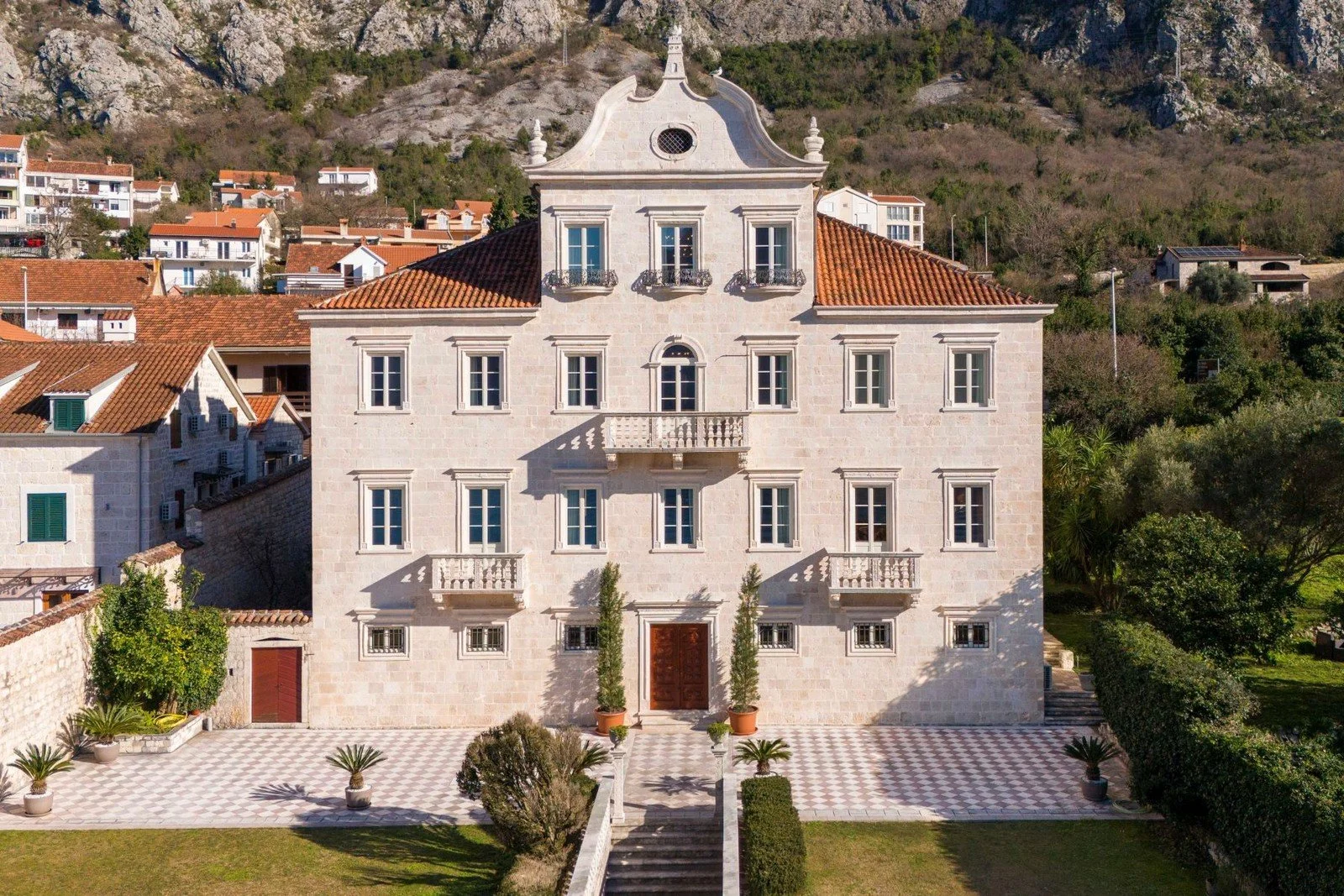
One of the finest ship master’s mansions dating back to the 18th century, Palazzo Tripkovic has been fully restored and offers private mooring on Boka Bay.
Dating back to the 18th century, Palazzo Tripkovic is considered one of the finest ship master’s mansions in Montenegro and offers private mooring for a large yacht on Boka Bay.
Registered with a historic designation, the ‘Captain’s Palace' is set in the village of Dobrota, which was once one of the most important Mediterranean maritime centres in the world.
Set high above the scenic shores along with an enclosed port and defense wall bearing the family’s coat of arms, Palazzo Tripkovic is named for the man who built it, Captain Andrija Tripkovic, head of the local commune and was a member of the Kotor administration.
The Tripkovic were one of the most important families in Dobrota and greatly influenced trade, construction, and cultural development throughout this region in the 18th and 19th century.
At one time, the Tripkovic family owned 18 vessels, with 63 members of the family ranked as ship captains.
The Montenegro property has been painstakingly restored over several years under the guidance of local experts and using original materials.
Palazzo Tripkovic is built of finely carved Korcula stone decorated in the Baroque style, with balustrades, cornices, and even a belvedere pediment crowning the top of the residence.
Spanning 11,840 Sq Ft, the residence offers 7 bedrooms and 7 bathrooms across 4 levels.
Surrounded by thick stone walls with terraced gardens, this waterfront property offers stunning views of the Bay of Kotor.
All photos belong to the listing agency.
13th Century Farmhouse and Catalan Estate in Girona, Spain
Sprawling over 120 hectares (297 acres), the Spanish estate is set in the Empordà region, a famed gastronomic route with numerous winegrowers and Michelin-starred restaurants.
This historic property in Spain is a true Catalan gem, offering 3,200 m² (34,445 ft2) of built space with 8 bedrooms and 4 bathrooms.
Set within the picturesque province of Girona, the Spanish property effortlessly marries old-world charm with modern potential, featuring a versatile open-concept space in the former stables, and a 13th century farmhouse, waiting to be restored.
The farmhouse blends modernist and Catalan Noucentista styles, creating a unique aesthetic. Its features include a grand semicircular arch, a detailed Gothic window, and neo-Gothic elements added in 1900.
The fortified entrance, where historical agricultural treatises were once written, adds further character and historical depth.
Beyond the main house, the estate features several historic structures. The former stables, now a 200 m² (2153 ft2) versatile space, were refurbished in 2002 and offer endless possibilities.
Unique to this property are two beams built by Gustave Eiffel’s company in the 1870s when he was commissioned in Girona, before embarking on the construction of the Eiffel Tower in Paris.
Sprawling over 120 hectares (297 acres), the Spanish estate is a sanctuary of natural beauty, with 75 hectares (185 acres) of forest and 45 hectares (111 acres) of hazel and chestnut woodland.
A 100-foot deep well ensures a plentiful water supply, making the estate as practical as it is beautiful.
This estate isn’t just a residence; it’s a canvas for your vision. With its historical charm and expansive grounds, it has the potential to be transformed into a boutique hotel or an exclusive event venue. The existing structures, including modern office spaces in a converted barn, provide a versatile foundation for various projects.
Just15 minutes from the Girona-Costa Brava airport and 30 minutes from the historic center of Girona, the Catalan estate's location also offers easy access to charming towns and cultural sites.
The Empordà region, famed for its wines, presents a delightful gastronomic route with numerous winegrowers and Michelin-starred restaurants. Coastal towns like Lloret de Mar and Sagaró are within easy reach, adding to the estate's allure.
Golf enthusiasts can enjoy the nearby PGA Caldes de Malavella, just 10 minutes away by car.
All photos belong to the listing agency.