Michael Douglas’ Villa S’Estaca in Mallorca is the Ultimate Mediterranean Retreat

The property was put on the market in 2014 and despite multiple price reductions (from €55M to €25M) and a promotional video narrated by Douglas himself released in 2019, there were no serious offers. As of May 2020, the property has been taken off the market.
Off the market, previously listed with Engel & Völkers.

Michael Douglas’ Villa S’Estaca is the ultimate Mediterranean retreat and was one of the most exclusive properties on the market in Mallorca. The property was put on the market in 2014 and despite multiple price reductions (from €55M to €25M) and a promotional video narrated by Douglas himself released in 2019, there were no serious offers.

As of May 2020, the property has been taken off the market. It is rumored that he loves the island too much to leave for good and will buy out his ex-wife Diandra Luker’s share of the property instead. 

Valldemossa, Mallorca, Spain

Valldemossa, Mallorca, Spain

The 190 acres property is set on the outskirts of the village of Valldemossa, offering direct access to the sea through a small village S’Estaca at the bottom of the property.

Mallorca

Michael Douglas purchased the estate in 1990 for a reported $3.5M after visiting Mallorca and falling in love with the property, located high up in the Tramuntana mountains.

He spent $7M on restorations and renovations to the Moorish-style estate, which offers 7 units that can accommodate up to 20 people across 5 apartments, a loft, and 2 cottages totalling almost 11,000 sq ft.

There is a home cinema, a gym, a shower with sea views, a spa, and a swimming pool, although our favourite feature is the view overlooking the Mediterranean from the several terraces on the property.

He planted vineyards which produced a local award-winning wine (stored in his own wine cellar), and a vegetable patch which includes squash, tomatoes, almond and olive trees. The luxury estate is entirely off-the-grid, with its own spring water well and power generator.

vegetable patch

Over the years, S’Estaca would become his spiritual home and Douglas would spend up to 6 months out of the year living in Mallorca. At one point he opened a restaurant and cultural centre on the island, Costa Nord, which has since closed.

On selling the property, Michael Douglas explained, “My life has taken a new course, and now it’s time for me to let someone else enjoy the privilege and adventure of S’Estaca.” He believed the right buyer would be “someone who will appreciate the beauty, the privacy and the uninterrupted views. Someone with the vision and the spirit of the creator of S’Estaca, Archduke Ludvig Salvator.”

In 1867, a 20-year old Archduke Ludwig Salvator of Austria, a Habsburg, arrived in Mallorca for the first time and fell under the spell of the deep blue Mediterranean Sea and clear skies. He purchased the property and renovated it in the 1860s, with the addition of a carved set of stairs to the stone bluff beneath the cliffside villa. It is rumored he also built a bathhouse for one of his mistresses, his own cousin Sisi, empress of Austria.

He would spend almost 30 years buying up land between Valldemossa and Deia and eventually his estate included the 16km of coastline between the two villages. A lover of nature and animals, Ludwig became known for his local explorations on his yacht. He wrote many books on the area, and spent 22 years writing a 9-volume work on the Balearic islands titled ‘Die Balearen’.

Nixie I, Yacht of Archduke Ludwig

Nixie I, Yacht of Archduke Ludwig

Mallorca, also called Majorca, is the crown jewel of Spain's Balearic Islands, known for its natural beauty and pristine beaches. The S'Estaca estate would be a truly unique opportunity to own a historic and romantic estate unlike any other in the Mediterreanean.

All photos belong to the listing agency.

Read More

What’s Poppin’ on the French Riviera?

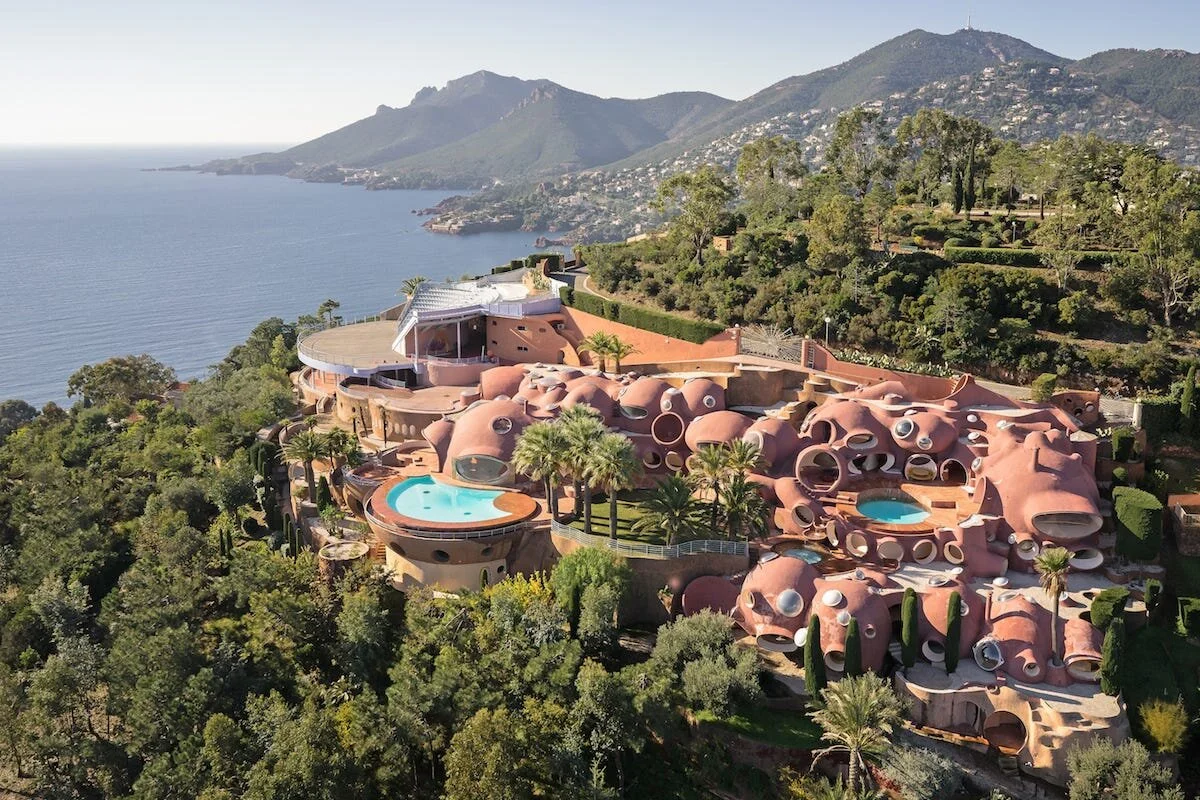
Designed by Hungarian architect Antti Lovag, the Bubble Palace is a property that looks like something you’d find on Tatoonie in the StarWars universe, or something we may very well one day see on Mars.

The futuristic home is listed for an undisclosed price by Michaël Zingraf, an Affiliate of Christie’s International Real Estate.

Every so often, we come across a unique property that almost defies description. The Bubble Palace looks like something you’d find on Tatoonie in the StarWars universe - although we think it could be something SpaceX may one day build on Mars.  

francis york bubble palace

The property has 10 suite pods with 11 bathrooms, built over 6 levels on the Massif de L'Esterel, a red-hued mountain range in Théoule-sur-Mer, near Cannes. There are 3 swimming pools, waterfalls, and a 500-seat amphitheatre with views overlooking the Mediterranean Sea. 

bubble palace francis york

The unique curvy design features almost 13,000 square feet of space in clusters of interlinked pod suites, as round inside as they are outside, with round doors, elliptical windows, and wave-inspired staircases. 

The property was designed by Hungarian architect Antti Lovag, known for his organic architecture and experimentation with sculptural approaches to residential design. 

He did not consider himself to be an architect but rather a ‘habitologist’: “Architecture does not interest me. It is humanity, the human space that interests me – creating envelopes around human needs. I work like a tailor. I make made-to-measure envelopes; envelopes that can be reshaped at will”. For Lovag, architecture was a "form of play- spontaneous, joyful, full of surprise" and he wanted to go back to the roots of our ancestral habitats, i.e. the cave. (The bubble house is said to be a modern interpretation of a cave dwelling.)

francis york bubble palace

He designed his first prototype for a “bubble house” in 1969 for French industrialist Pierre Bernard (Maison Bernard is now open to the public), but it was the Palais Bulle that would place Lovag at the forefront of 1970’s radical architecture. 

The Bubble Palace took 14 years to build, from 1975 and 1989. After Bernard’s death in the early 90’s, the property was purchased at auction by fashion designer Pierre Cardin as a summer home and creative sanctuary.

bubble palace francis york

 “Clinging to the rocky Estérel, this palace has become my own bit of paradise. Its cellular forms have long reflected the outward manifestations of the image of my creations. It is a museum where I exhibit the works of contemporary designers and artists.” 

bubble palace francis york

Known for his Space Age designs, the property was a natural choice for Cardin, whose rise to fame is noted with the smashing success of his “bubble dress” design in 1954. The Dior Resort 2016 Fashion show took place at the Palais Bulles, notable not only for its instagram-worthy backdrop: Cardin was head of coats and suits at Christian Dior when he launched his own fashion house in 1947.

Bubble-with-Pool-2.jpg

He wanted the property to become a destination to appreciate creativity and artistic expression, and each year he hosts one of the most sought-after festivals on the Riviera (outside of the Cannes Film Festival, of course). His glamorous parties attracted high-profile actors, models, and fashion icons to party in style at Palais Bulles. 

The futuristic home is rumoured to have been on the market in 1989 for $455 million and then $355 million in 2015, but never sold and was taken off the market. 

All photos belong to the listing agency.

Read More

A $600M Art World Scandal Surrounded this Sutton Square Residence

At the time it was listed, Wildenstein was facing up to 2 years in prison and a substantial fine for an alleged $600M inheritance fraud, considered one of the biggest tax fraud trials ever held in France. He was cleared of all charges - twice - but its a cautionary tale of French inheritance laws.

This property is listed for $29,500,000 by Loy Carlos and Carrie Chiang of The Corcoran Group.

The property first made headlines in 2018, when it was listed for $39.8M by art mogul, Guy Wildenstein, reported to be selling off his real estate holdings in New York.

At the time, Wildenstein was facing up to 2 years in prison and a substantial fine for an alleged $600M in inheritance fraud. It was considered “one of the biggest tax fraud trials ever held in France”. He was cleared of all charges - twice - but its a cautionary tale of French inheritance laws. 

His family business, Wildenstein & Co. was one of the most successful and influential art-dealerships of the 20th century. When his father, Daniel Wildenstein died in 2001, Guy and his brother Alec declared an inheritance of €40M. 

Under French inheritance law you can be taxed up to 50% of the estate, and so they paid out €17.7M in rights and taxes with a group of marble sculptures commissioned by Queen Marie Antoinette for the Château de Rambouillet. They’re on display in the Louvre today, 

In the case against him, it was alleged that Wildenstein and his brother moved millions of dollars of artwork from New York to Switzerland within days of their father’s passing in 2001. He was accused of concealing a considerable fortune, comprising priceless art, real estate holdings, funds, and race horses, reportedly worth billions "behind foreign legal structures, escaping taxes."

His lawyers argued that reporting a trust was not clearly required by French tax authorities until 2011, and the verdict was that he was not guilty. Indeed, it wasn’t until 2011 that France passed a law, (dubbed the “Wildenstein law”, no less) which granted tax authorities greater power to investigate trusts in tax havens.

The court, unable to prove that Wildenstein’s trusts were still in use after the law came into effect in 2011 and without a proper investigation of their tax havens in the Bahamas and the Channel Islands, had no “legal basis” for their case. In 2018, Wildenstein was finally cleared of all charges for the second time.

Two neighboring townhomes were combined to create this rare 33 foot wide residence on Manhattan’s Sutton Square. With a gated driveway and a lush private garden, the 5-bedroom Georgian-style townhome has spectacular East river views. 

The classical interiors were designed by world-renowned designer Juan Pablo Molyneux, Notable details include a beautiful glass rotunda in the foyer and, and elegant finishes throughout, like the parquet de Versailles flooring in the great room. The oak-panelled double library overlooks the river, as does the glorious rooftop terrace with a bar for entertaining which includes a bar. The property also has a gym, sauna, and separate staff quarters on the lower level. 

All photos belong to the listing agency.

Read More

Dreaming of Paris

Located a short walk from the Arc du Triomphe, in the 8th arrondissement, this apartment is on the 4th floor of a Haussmannian building. Elegantly designed and renovated, this 3 bedroom apartment also features views of the Arc du Triomphe from its windows and balconies.

This property is listed for € 6,800,000 by Valérie Selignan of Daniel Feau Real Estate

Paris is definitely one of our favourite cities in the world, and a place we visit again and again. With that in mind, we can definitely see ourselves in this 8th arr. Parisian apartment. 

On the 4th floor of a Haussmannian building, this elegantly designed and renovated 3 bedroom apartment features views of the Arc du Triomphe from its French windows and balconies.

What is a Haussmanian building you ask? 

Well, by the mid 19th century Paris was a far cry from the city many of us know and love today. It was hugely overcrowded, which led to crime and disease running rampant.

Paris had evolved from a pre-medieval city with little to no planning: its streets were narrow, dark and winding, some only 1 to 5 metres wide. Its crumbling buildings were built one on top of the other, and getting around central Paris was difficult, to say the least.

Victor Considerant, a socialist reformer, wrote: “Paris is an immense workshop of putrefaction, where misery, pestilence and sickness work in concert, where sunlight and air rarely penetrate...where plants shrivel and perish”

When he was elected as president, Louis-Napoleon, Napoleon's nephew, said in a speech: "Paris is the heart of France...Let us open new streets, make the working class quarters, which lack air and light, more healthy, and let the beneficial sunlight reach everywhere within our walls." 

He hired the prefect of the Seine department, Georges-Eugène Haussmann to “aerate, unify, and embellish” his capital. Between 1853-1870, he carried out what are commonly referred to as the Haussmann’s Renovations of Paris, enlisting 3000 workers to modernize the city. 

Levelling much of old Paris, he replaced the crowded buildings with tall apartment blocks and wide avenues punctuated by large squares and monuments. Before Haussmann, Paris had only 4 public parks; now, Parisians could walk to a park in the city in 10 minutes or less.

Haussmann saw city blocks as a single unit, and each building was seen as part of the entire block: on the outside, the facades were regulated to ensure a uniform look in height, colour, material and design, while interiors were left to the owners. 

Today Haussmann’s apartments are an icon of the city’s aesthetic. 

All photos belong to the listing agency.

Read More

A 1920s Mansion Built In the Golden Automotive Era of Detroit

Remnants of a long lost golden era, this amazing mansion looks like something out of The Great Gatsby. However it’s a remnant of the Golden Automotive Era, when Detroit was once an elite American city.
This property is listed for $4,750,000 by Jeffrey Llaneza of Signature Sotheby's International Realty.

Remnants of a long lost golden era, this amazing mansion looks like something out of The Great Gatsby. However it’s a remnant of the Golden Automotive Era, when Detroit was once an elite American city.

In 1903 Henry Ford founded the Ford Motor Company, within a decade Ford's assembly line concept would set off a revolution in auto manufacturing and make Detroit the automotive capital of the world.

The city of Detroit saw its population skyrocket from 285,000 in 1900 to over 1.5 million in 1930, growth of more than 426%. At its peak, Ford’s River Rouge plant had more than 100,000 workers alone, and a new Model T rolling off the assembly line every 49s. Industry was booming.

Riches from the manufacturing industries spilled over to other industries too, and like New York, Detroit's wealthy used their fortunes to build incredible mansions. Many still remain today, and on the shores of Grosse Pointe this one may be the cream of the crop. 

The home was designed in 1929 by Smith, Hinchman & Grylls for Hal H. Smith, a partner in the prominent law firm: Beaumont, Smith and Harris, and a known patron of the arts.

Interestingly, Smith, Hinchman & Grylls is one of the oldest and largest architectural firms in America. Today known as SmithGroup, in 2018 Architectural Digest listed it among the top 50 architectural firms in the US.

This 14,500+ sq ft home sits on nearly 2 acres with 200’ of water frontage. Inside, one finds a 2 storey, 1000 sqft library. It’s really something to see; the walls are covered with walnut panels and bookcases which have 2 hidden staircases connecting the upper and lower levels. 21 feet above, the curved ceiling features a mural depicting angels and the Seven Deadly Sins. It took local artist Andrzej Sikora nearly a year to paint. 

The rest of the home has 5 luxury bedrooms with ensuite baths, mural painted ceilings throughout, as well as a third floor screening room. Outside you can find a bluestone patio with heated inground pool, and greenhouse. In front, there is a 4 door garage with space for 6 cars.

Read More

Thomas Jefferson’s Palladian Residence is One of America’s Architectural Gems

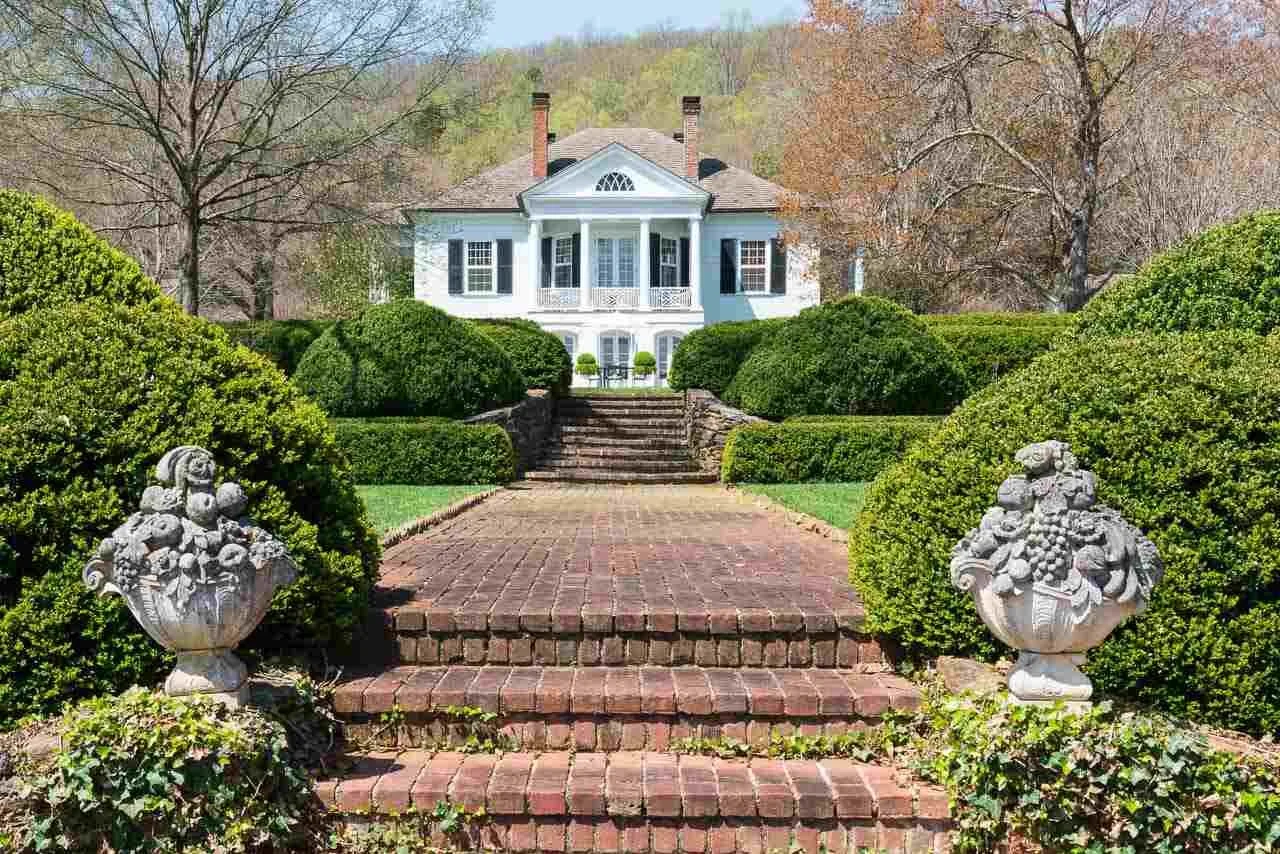
Edgemont is a Jeffersonian jewel surrounded by 572 acres in the foothills of the Blue Ridge Mountains.

This Founding Fathers’ Palladian residence is one of America’s architectural gems, surrounded by 572 acres in the foothills of the Blue Ridge Mountains. Designed with symmetry and classical proportions by Thomas Jefferson, Edgemont is based on the Villa Capra (La Rotonda) in Vicenza, Italy and features classic Palladian features, seen in the hipped roof and pedimented porticos on all four sides. It’s said that Jefferson also anonymously submitted a design based on the Villa Capra for the White House that was ultimately rejected. 

Considered one of America’s architectural gems, Edgemont was inspired by the work of 16th century Italian architect, Andrea Palladio, whose classical style emphasized symmetry, proportion, and the use of columns. Palladio’s Four Books of Architecture became Jefferson’s architectural bible and would come to define the Jeffersonian style, often referred to as an American form of Neo-Classicism and Neo-Palladianism. 

Inspired by the ancient Roman precedent, which forms the foundation of classical architecture, Jefferson rejected colonial and Federal architecture, which he considered “second-rate, provincial work”. He is often noted as one of the founders of American architecture - in addition to his role as one of the Founding Fathers. He spurred on the Classical Revival movement, driven by his concern “for the architectural image of the nation he helped create”. (Classic Commonwealth: Virginia Architecture from the Colonial Era through 1940

Jefferson’s architectural legacy includes the State Capitol in Richmond and, after his retirement, the University of Virginia, where he designed “ a distinctive, U-shaped design of connected pavilions and a domed Rotunda circling a long, narrow green space.” He is best known for his private residences, and most notably for Monticello, a plantation in Albemarle County. (You can tour the house and gardens of Monticello today

Click here to read about another Palladian gem, Villa Cornaro, which inspired Jefferson’s Monticello residence [Francis York Journal]

The 8-bedroom, 7.5 bathroom home is gorgeously appointed with molded cornices, wainscotting, mantels, timbered ceilings, and many other original details - including a hidden staircase, one of Jefferson’s favorite design features. The entire walls of the reception hall feature an intricate painted mural of a hunting scene by Zuber & Cie. Edgemont is listed on the National Register of Historic Places as well as the Virginia Landmarks Register.

Edgemont is listed on the National Register of Historic Places, the Virginia Landmarks Register, and is part of the Southern Albemarle National Register Rural Historic District.

All photos belong to the listing agency.

Read More

A Boca Rococo Palm Beach Mansion Lists for $47.5M

In the 1920s, Mizner was the most-discussed living architect in America. He was hired in 1924 to transform the city of Boca Raton into "the foremost resort city on the North American continent…a resort as splendid in its entirety as Palm Beach is in spots."

This property is listed for $47,500,000 by Christian J. Angle of Christian Angle Real Estate.

This South Ocean Boulevard retreat is known as El Solano, and is positioned on a slender stretch of coastline neighbouring several billionaires’ second homes. The property comes with a tennis court, two swimming pools, and a beachfront cabana. An eclectic example of Spanish colonial architecture, this seven-bedroom, 14,145 square foot mansion was built by the "society architect" Addison Mizner in 1925. 

In the 1920s, Mizner was the “most-discussed living American architect”. He was hired in 1924 to transform the city of Boca Raton into "the foremost resort city on the North American continent”.."a resort as splendid in its entirety as Palm Beach is in spots."

Famous for his defining style of Mediterranean Revival architecture, Mizer would utilize various methods of vandalism (burning pots of tarpaper, cracking mantles with sledgehammers, rusting iron with acid) to patina his structures and create a look he called “the kiss of the centuries”. Most notably, his use of worm-eaten cyprus, worthless for structural elements but beautiful for it’s aged appearance, became the “mahogany paneling of Palm Beach”.

He had successfully set up the Mizner Development Corporation with a board of high society contacts, and used his fame and reputation as a Palm Beach builder to project the idea that investing in Florida property was akin to “gold”. Unfortunately, Mizer was as off the cuff with his eclectic styles as with his financial planning, and his "extravagant imagination outstripped his budget and the market." 

Although he had sold over $2 million in lots on the first day of sales for Boca Raton, most of the lots were not paid for and Mizner didn’t actually have the money he needed to build. By 1926, the land boom collapse would send Mizner into bankruptcy, marking the beginning of the end of his career as an architect. 

Mizner died in 1933, but his legacy and story would live on in books, and eventually on Broadway. Stephen Sondheim’s musical ‘Road Show’ was based on Addison Mizner and his brother, Wilson Mizner, a “businessman, raconteur, con man, professional gambler, and playwright, whom Addison called "my chief weakness and dreaded menace". The musical follows the “adventures of the brothers across America, from the beginning of the 20th century during the Klondike gold rush, to the Florida real estate book of the 1920s”, with many creative liberties taken in the accounts. 

Today, few of Mizer’s original mansions remain and the Palm Beach mansion is most famous for being the former residence of John Lennon and Yoko Ono, purchased shortly before his untimely death in 1980.

All photos belong to the listing agency.

Read More

Hinwick House is on the market for the 3rd time in 300 years

Architect John Hunt of Northampton based the design on Buckingham House, which today forms the central portion of Buckingham Palace, the Queen's famous residence.

This property is listed for £8,500,000 by Crispin Holborow and Hugh Maconochie of Savills

Located in Bedfordshire and Northamptonshire, the Manor house sits within its very own park of nearly 37 acres. There are formal gardens, including a Georgian walled garden, an orchard, mature parkland, 2 lakes, woodland, and a stream. Hinwick was built in the Queen Anne style and the property features 20 bedrooms total between the main house, with its Victorian wing addition, and other structures covering a total 18,600 sqft.

The other structures include stables, store rooms, an 18th century clock tower, dovecote (for your pigeons), and 3 estate cottages.

History

The history of Hinwick House reaches back to the 15th century. There are three turret cottages which have been converted from a manor house that stood on the property at that time. The estate was purchased by the Orlebar family in 1653 for £355, around £85,000 or $104,000 USD in 2020 currency. 

Richard Orlebar and his wife, Diana Astry, known for her cookbook, began building the current home in 1710 with completion in 1714. Architect John Hunt of Northampton based the design on Buckingham House, which today forms the central portion of Buckingham Palace, the Queen's famous residence. 

Between 1859 and 1860, Richard Longuet Orlebar carried out renovations on the home, which included adding the Victorian north wing. Remarkably, the home stayed in the family for nearly 300 years until 1995, when it was sold.

During that period of ownership, the house was used as a school in the 1880s, a hospital for soldiers between 1914-1918, and a restaurant in 1990.

The home fell into disrepair after the family sold it, and in 2014 Sam and Nina Singh purchased the estate for a reported £4.5 million, then invested an additional £3.8 million  for a restoration that according to the RobbReport, spanned 2 years and included more than 120 artisans and craftsmen.

All photos belong to the listing agency.

Read More

A Billionaire’s Beach House in Malibu, Designed by Richard Meier

Nicknamed "Billionaire's Beach," the Carbon Beach section of Malibu is renowned for its oceanfront homes (built right on the sand) and unobstructed sea views (no sea walls here). The property belongs to billionaire Eli Broad, worth $6.8B.
This property is listed for $75M  by Branden and Rayni Williams of Hilton & Hyland. 

Nicknamed "Billionaire's Beach," the Carbon Beach section of Malibu is renowned for its oceanfront homes (built right on the sand) and  unobstructed sea views (no sea walls here). 

This contemporary beach home belongs to billionaire Eli Broad, a serial Fortune 500 creator of humble beginnings. As a son of Jewish Lithuanian immigrants, he worked his way through college, and co-founded a property development company with borrowed money from his in-laws that would become one of the nation’s biggest builders. 

He then bought Sun Life Insurance, transformed it into Sun America, and sold it for $18B in stocks. Now a philanthropist with his wife, Broad supports the arts with various foundations and opened a contemporary art museum in California, free to the public. 

Architect Richard Meier. the award-winning architect behind the Getty Centre and Barcelona Museum of Contemporary Art, among others, designed the striking property, described as “residential art”. 

"Whiteness allows the architectural ideas to be understood most clearly—the difference between opacity and transparency, solid and void, structure and surface," Meier explains, of his characteristic aesthetic. "They have a greater clarity."

The beach house boasts 105 feet of frontage on Malibu’s coveted beach front, with the interior aesthetic designed by Rose Tarlow.

The unique design is just one example of Broad’s philosophy to challenge the status quo and conventional wisdom in life, which he claims is the secret to his success. No stranger to pushing the envelope, Broad published a controversial opinion piece in The New York Times in late 2019, titled: “I’m in the 1 Percent. Please, Raise My Taxes.” 

All photos belong to the listing agency.

Read More

A Muse, Mistress, and Patron of the Arts: The Story Behind Château de Menars

It’s any billionaire’s dream pad, but there is more to the story behind one of the few privately-owned châteaux in Loire Valley.

This property is listed for €31,500,000 byJean-Pierre Piganoil of Val de Loire Sologne Sotheby's International Realty Sothebys International Realty

It’s any billionaire’s dream pad, but there is more to the story behind one of the few privately-owned châteaux in Loire Valley. 

Château de Menars belonged to Edmond Baysari, a Lebanese-born, Monaco-based property developer with a passion for art, architecture, and history. Well into his 80s and without apparent heirs, the UNESCO-listed property was put on the market in 2017.

The €31.5M price tag is a fraction of the €100M he has put into restoring it over the past 30 years, and he is hoping the property stays intact. It is rumoured he has turned down 9-figure deals from Russian Oligarchs and Middle Eastern billionaires.

The sale handler, lawyer Jack Anderson is committed to Baysari’s goal: “to know that it’s in the hands of someone who’s going to continue the beauty of the chateau and maintain it”. Find the listing here.

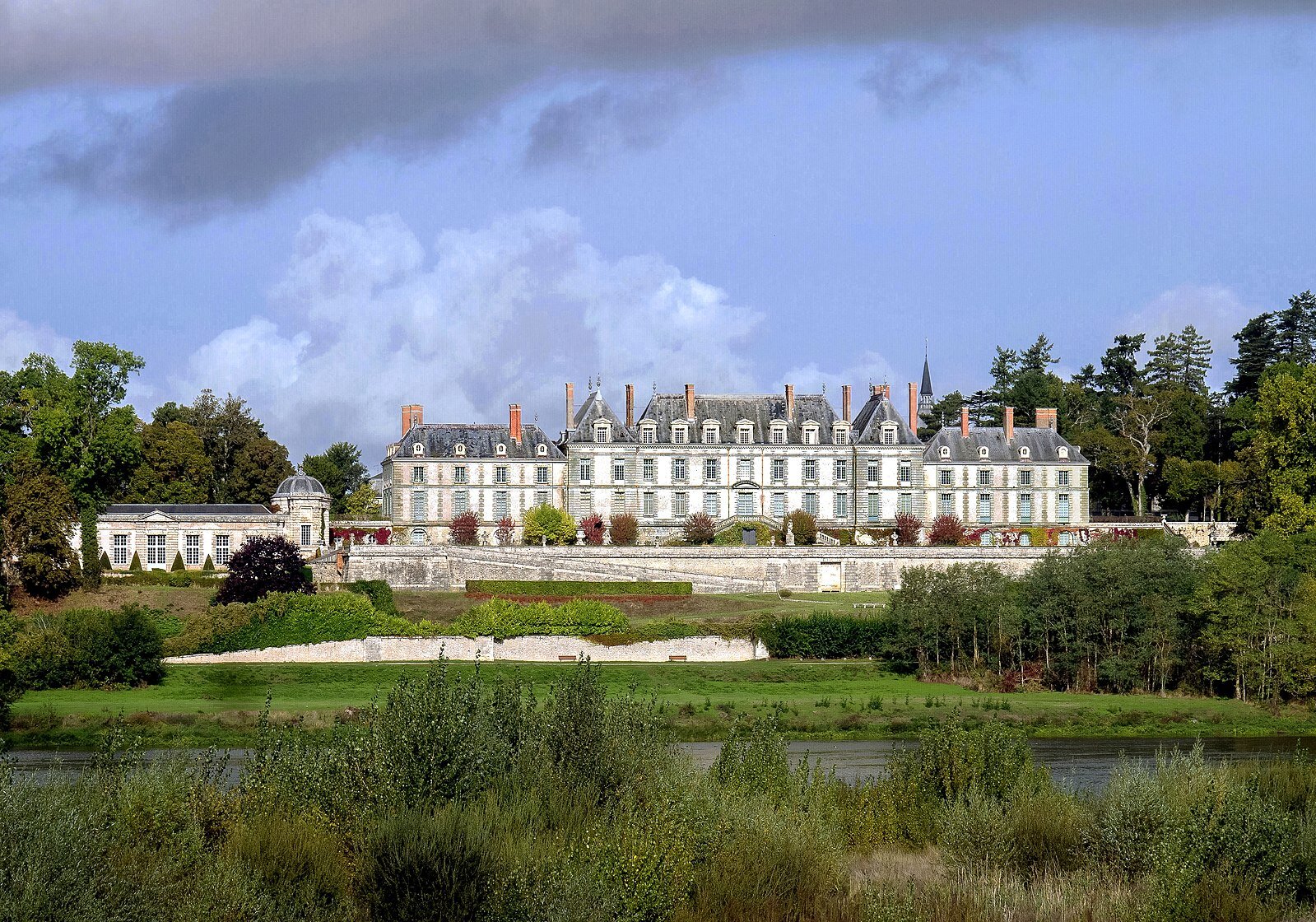
Château de Menars, (Starus via Wikimedia Commons)

Château de Menars, (Starus via Wikimedia Commons)

The annual upkeep of the 50-bedroom château is roughly €400K. This includes the maintenance of lavish geometric gardens designed by famed landscape architect Le Nôtre, the principal gardener of King Louis XIV of France who also designed the gardens are Versailles.

The property boasts the longest avenue of century-old lime trees in Europe, stretching 4 km long. The terraces extend to the banks of the Loire, dotted with 18th century statues of Roman emperors. Vineyards on the property yield pinot noir and there is a 30,000 bottle wine cellar. 

Baysari referred to his 130,000 square foot, 104-acre estate as "Palace Pompadour", after his muse.

The 30-year restoration project is a labour of love. "Very early I came across this woman in my readings, and I was immediately passionate about her," says Baysari, recalling when he first heard of Madame de Pompadour as a young child.

Château de Menars once belonged to Madame de Pompadour, the maîtresse-en-titre (Royal Mistress) of King Louis XV, a true Renaissance woman whose influence on art, style, and politics changed the world.

Detail from Madame de Pompadour, 1756, by François Boucher, WikipediaHow can Madame de Pompadour be a ‘Renaissance woman’ when she was born in 1721? The term ‘Renaissance woman' (or man) was originally used to describe the qualities of a polymath fr…

Detail from Madame de Pompadour, 1756, by François Boucher, Wikipedia

How can Madame de Pompadour be a ‘Renaissance woman’ when she was born in 1721? The term ‘Renaissance woman' (or man) was originally used to describe the qualities of a polymath from the Renaissance period.

A basic tenant of Renaissance humanism is that humans are limitless in their capacity for development. Leonardo da Vinci has often been described as the archetype of the Renaissance man, a man of "unquenchable curiosity" and "feverishly inventive imagination".

The term was first recorded in the early 20th century to refer to the qualities of Renaissance polymaths, although today it is commonly used to describe someone who has broad intellectual interests and is good at many things.

Baysari's lawyer, Jack Anderson, reportedly said "She was a Renaissance woman, and he was a Renaissance man”, when explaining Baysari’s fascination with Pompadour.

Born Jean Antoinette Poisson in 1721 to a promiscuous mother and a penniless father who fled the country to escape his debts, she was just four years old when she came under the legal guardianship of Jean Pâris de Montmartel. A wealthy tax collector who paid for her education, he was rumoured to be her biological father.

At the age of nine, her mother took her to a fortune teller who predicted she would “one day reign over the heart of the King”. Her destiny was sealed: from that time she was called “Reinette”, meaning "little queen". Her family set out to groom Jean Antoinette to become the mistress of Louis XV, and she was educated in dancing, drawing, painting, engraving, theatre, the arts, and attained the ability to memorize entire plays.

Even her marriage at 19 to her guardian’s nephew, Charles-Guillaume Le Normant d’Étiolles, did little to prevent her from fulfilling her destiny. Shortly after they wed, Jeanne-Antoinette and her husband acquired a château in Senart near Louis XV’s hunting lodge, where she would ride horseback on the King’s hunt days hoping to catch his eye.

In 1745, she received an invitation to a lavish masquerade at Versailles in celebration of the marriage of the Dauphin of France and Maria Theresa, Infanta of Spain.

Winners of Best Costume? Six gargantuan turbaned Turks are seen in this 1764 etching of the Yew Tree Ball in 1745, celebrating the marriage of Louis XV's son, Dauphin of France, and Maria Theresa, Infanta of Spain. Charles Nicolas Cochin, (The Met Museum)

Held in the Hall of Mirrors, there were 1,500 in attendance. Many were costumed in elaborate Turkish and Chinese costumes, reflecting the exoticism that was vogue in 1740s Paris. Jeanne-Antoinette arrived dressed as Diana, the Roman goddess of the hunt.

Louis XV, dressed as a topiary yew tree along with several servants alongside him, dramatically unmasked himself and finally declared his reciprocated feelings for her that night. That event came to be known as the Yew Tree Ball because of the King’s costume.

Within a month, she had abandoned her husband and daughter for the King. Given the title of the Marquise de Pompadour, she moved into a private apartment in the palace, with a private circular staircase giving her direct passage to the Kings chambers. 

Madame Pompadour, by Francois Boucher (Wikimedia Commons)

Madame Pompadour, by Francois Boucher (Wikimedia Commons)

The passionate nature of their relationship was no secret in court. The King allegedly moulded the traditional French champagne glass into the shape of one of her breasts; he also commissioned a diamond cut in the shape of her lips. The first of its kind, the cut became known as the Marquis cut, although it is also known as the “navette”.

Designed in the shape of the Marquise of Pompadours lips, the Marquis diamond cut, is also known as the navette cut.

After four years at court, Pompadour would even be elevated to lady-in-waiting to the Queen, the most noble rank possible for a woman at court. Madame de Pompadour got along so well with Queen Marie, that she allegedly remarked "If there must be a mistress, better her than any other."

Ultimately, she would became his trusted advisor, but she grew her influence over the king as a friend who enriched his life with gaiety and lightness. Before their relationship, the King’s main pastime was hunting. She would never tire of entertaining the easily bored royal, often writing and acting in plays for the King to uniquely showcase her wit and charm.

She expanded his worldview with books, art, and culture with her collections of object d’art: a “myriad of paintings, sculptures, and chinoiseries that Pompadour patronzized, commissioned, and collected” (It is said that the sale of her effects after her death lasted for more than a year.)

King Louis XV, Portrait by Maurice-Quentin de La Tour, 1748

King Louis XV, Portrait by Maurice-Quentin de La Tour, 1748

Pompadour’s position in court was highly sexualized and highly politicized in a time when courtiers were openly vying for power and influence with Louis XV.  The Marechale I de Mirepoix used to say to Madame de la Pompadour “It isn’t you he loves, it’s your staircase”, but their relationship was much more than just physical. 

According to Columbia University art historian Susan Wager, "She was mediating between members of the court and the king. They would say 'I want to say this to the king.' And she'd say, 'No, wait, let me tell him. Let me translate it into my own words and I'll come back to you.' She was, in all sorts of ways, manipulating this idea of the staircase — of the passage — in an artistic, in an intellectual and in a political way.” 

She is said to have declared unapologetically, "I am stubborn in the service of the King and I won't hold back in anything”, and “effectively played the role of prime minister, becoming responsible for appointing advancements, favours, and dismissals, and contributing in domestic and foreign politics”.

When the relationship changed in 1750 (diaries and letter report that Pompadour switched floors in Versailles), Wagner states "What's really remarkable is that she still remained at court in the position of official mistress for the rest of her life even though there was no longer a sexual relationship". 

As the King’s mistress, Pompadour was no stranger to controversy. As a contemporary and friend of Voltaire, a thought leader of the Enlightenment, she was also outspoken about her beliefs as a champion of free thought. 

She openly opposed the Catholic Church by supporting the creation of the French Encyclopedia, which discussed ideas of the Scientific Revolution. She made waves in political circles, ultimately influencing the King to break a Peace Treaty with Prussia and she was ultimately blamed for the brutal defeat in the following Seven Years War. 

Pompadour’s influence on French society and culture was vast-reaching, and she is often credited with making Paris the capital of taste and culture in Europe. Her love of porcelain led to Louis XV purchasing a porcelain factory in Sèvres in 1759, giving her influence on styles and designs of Sèvres Porcelain. The Chief chemist of Sèvres, Jean Hellot, was enlisted to create the most beautiful pink color ever seen, a shade named “Rose Pompadour”.

She helped bring on the European Rococo movement with her influence of the Rocaille style used liberally in the decorative arts. The light-hearted, French Rococo style she championed became known as the Louis XV style. She would decorate and often redecorate the 15 residences she had with the King, and was known for being a patron of both Rococo artists and the greatest royal patron of portraiture. She commissioned many portraits from leading artists of the day, and was often involved in the composition and direction of the paintings, which was unusual for patrons in this time.

Madame de Pompadour by François Boucher, 1758.

Madame de Pompadour by François Boucher, 1758.

In architecture, she sealed her influence when she elevated her brother Abel Poisson to the title of the Marquis de Marigny and gave him a new position as General Directeur des Batiments. An official government role, he worked alongside Madame de Pompadour and King Louis XV to plan and build several important French monuments and buildings, such as the École Militaire and the Place Louis XV – today the Place de la Concorde. 

The Petit Trianon at Versailles via Wikimedia Commons

The Petit Trianon at Versailles via Wikimedia Commons

After hiring architect Anges-Jacques Gabriel to build the Petit Trianon in Versailles, in 1760 she enlisted his expertise for what would be her last great work at Menars: a residence all her own.

She purchased it herself after selling off the Château de Bellevue to the King for his daughters; other reports suggest she sold jewelry and pearls to pay for the first instalment of construction. The château de Menars was part of her arrangements, should she outlive Louis XV or be forced to leave court.

Château de Menars was originally built in 1642 and Pompadour had big plans to refurbish the castle and build her dream home, adding flanking wings to the main château. Unfortunately she would never see Menars complete: Jeanne-Antoinette died in 1764 from tuberculosis. She was 42.  

Watercolor “portraitist” of houses, Nicolas Pérignon visited Château Menars and depicted what the palace would look like once complete (1761-64).

Watercolor “portraitist” of houses, Nicolas Pérignon visited Château Menars and depicted what the palace would look like once complete (1761-64).

Her brother, the Marquis de Marigny, would finish the restoration, but the property would sit quietly for over two centuries. In 1980 the property belonged to Saint-Gobain, a Parisian glass making company who would use the château for company retreats. When the company was nationalized by the French government, they were forced to sell Menars. 

That’s when Sotheby’s chairman Peter Wilson told Baysari about the sale. With a fortune amassed from a successful real estate career (he had retired at just 32), Edmond purchased the château for about €2M in 1983.

Born in Lebanon, then under French colonial rule, Baysari left for the Americas as a teenager. After receiving a Harvard education, Baysari opened a widely successful real estate business in Venezuela in the 1960s. He then returned to Harvard for a …

Born in Lebanon, then under French colonial rule, Baysari left for the Americas as a teenager. After receiving a Harvard education, Baysari opened a widely successful real estate business in Venezuela in the 1960s. He then returned to Harvard for a master’s degree in nuclear engineering, before ending up on Wall Street working as a consultant. After, he traveled the world and settled in Monaco as a full-time philanthropist, focused on the arts.

A close friend of Ronald Reagan, Baysari also contributed to the Art in Embassies program in 1990, an art sharing program between U.S. embassies. which would eventually grow into a worldwide network. The crowning achievement of his curatorship was undoubtedly Château de Menars.

U.S. President Ronald Reagan would visit Chateau de Menars for an informal summit with Soviet leader Mikhail Gorbachev, organized by Baysari. Other notable guests include Mick Jagger and Britain’s Prince Charles. Sir Gawain (Wikimedia Commons)

In 1989, Baysari finally “decided [he] wanted to make a gift to Madame de Pompadour and put it back to the way she would have it if alive today," employing the exact methods used in the mid-18th century to “revive” Menars.

Even with the €100M invested into the château, the ground-floor apartments that were once Madame de Pompadour’s bedrooms are still unrestored. "I don't want to do it. I don't think I'm qualified," says Baysari, "I would rather that when she comes back, she does it herself."

Baysari passed away in 2018 without a will. The sale of the property belongs to his estate is being managed by his niece and the Baysari group.

This incredible 100-acre estate is one of the largest châteaux on the market in the Loire Valley, and offers views looking over the Loire river. The property is being sold as a unique business opportunity for the right investor and includes an introduction to an international 5-star hotelier to develop the property. It’s an exciting project for an extravagant hotel complex in the most visited country in the world.  

If you've enjoyed this article, please share it with a friend or post it on your social media:
Twitter
| Facebook | LinkedIn.


Sources: 

Articles:
Forbes, “France's $100 Million Palace Pompadour: A Royal Chateau Restored By A Press-Shy Philanthropist”, Morgan Brennan, 2013. 
History Today, “Madame de Pompadour's Staircase”, Nancy Mitford, Published in History Today Volume 4 Issue 1 January 1954.
La Nouvelle Republique, “Ménars. Le propriétaire du château de Mme de Pompadour est décédé”, Catherine SIMON, 2018
NPR, “More Than A Mistress: Madame De Pompadour Was A Minister Of The Arts”, Sunsan Stamberg, 2016. 
Reuters, “Labor of love French chateau on market for $30 million”, Johnny Cotton, 2017. 

Books:
Goodman, Elise. “The portraits of Madame de Pompadour: Celebrating the Femme Savante” (Berkeley: University of California Press, 2000)
Hooper-Hamersley, Rosamond. “The Hunt After Jeanne-Antoinette de Pompadour: Patronage, Politics, Art, and the French Enlightenment” (Lexington Books, 2011) 

Read More